Renovate What Is Not Working—Without Creating New Problems Behind the Finish

Interior Renovation

A successful renovation is not simply a newer kitchen, fresher paint and better furniture. It is the process of deciding what should stay, what should be removed, what needs technical upgrading and which changes will genuinely improve the way the property works. Bella plans the renovation before demolition starts so layout, MEP, joinery, finishes, approvals, procurement and contractor sequencing are resolved as one project.

We renovate villas, apartments, individual rooms, kitchens, bathrooms and selected commercial interiors in Abu Dhabi and across the UAE. Depending on the brief, the work can range from a cosmetic refresh that keeps the existing layout to a deeper reconfiguration involving partitions, ceilings, electrical, plumbing, HVAC, waterproofing, custom joinery and complete finishes. The proposal defines where Bella is acting as designer, coordinator, fit-out partner or project manager so responsibility remains clear.

Room RefreshApartment RenovationVilla RenovationKitchen & BathroomMEP UpgradesFull Remodel
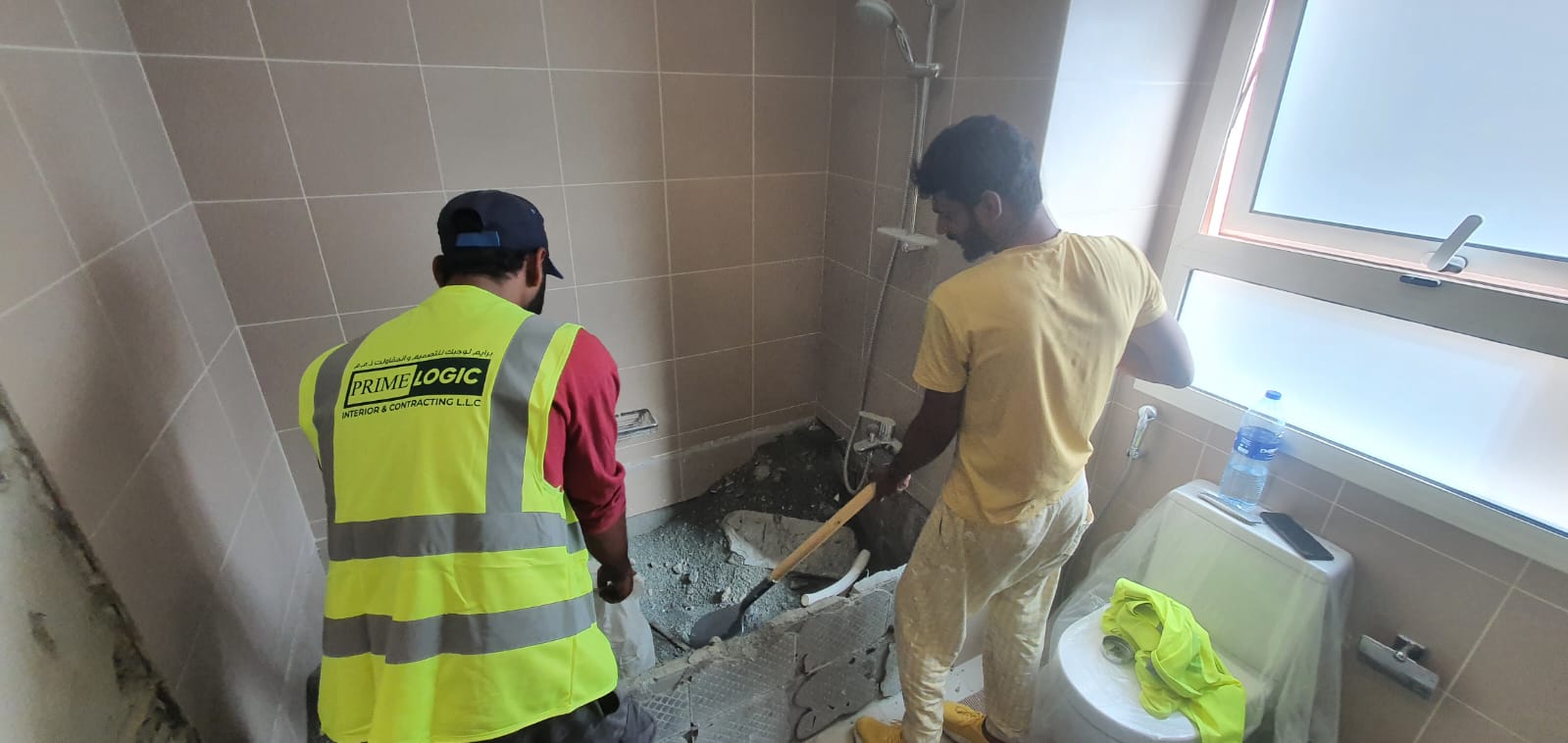
Abu Dhabi villa interior in the middle of renovation with workers, protected flooring, tools and wall finishing underway
Interior Renovation / Abu Dhabi Survey · Strip-Out · Upgrade · Finish

Define the Depth Before You Ask for a Price

Are you refreshing the finishes, replacing worn systems or changing how the property works?

Those are three very different renovation scopes. We establish the depth first because the wrong assumption at briefing stage is usually what creates the largest variation later.

01

The layout works; the property simply feels dated

A cosmetic or light renovation may be enough: repainting, flooring, decorative lighting, door / ironmongery changes, selected joinery fronts, curtains, furniture and styling. Keeping walls and wet-area points largely unchanged protects the budget and shortens the disruption.

02

The kitchen and bathrooms are worn out but I do not need to rebuild the entire home

We can focus the scope on the expensive service-heavy rooms. Keeping major drainage, water and extraction points close to their existing positions usually reduces demolition, approvals, MEP alterations and floor-level complications.

03

The apartment wastes space in corridors and closed rooms

We test a new plan against structure, doors, glazing, wet stacks, AC and furniture before proposing wall changes. In some properties a broken-plan solution—glazed partitions, wider openings or dual-purpose joinery—improves light and flow without turning every room into one open space.

04

The villa needs new services, not just new finishes

Older properties can reveal outdated distribution boards, pipework, waterproofing, AC equipment, insulation or ceiling services once opened. We identify likely upgrade zones before demolition and carry contingency for hidden conditions rather than spending the entire budget on visible finishes.

05

I want to remove a wall to create an open kitchen

The first question is structural and technical—not aesthetic. We confirm whether the wall is load-bearing or interfaces with structure / services, assess the MEP consequences and determine the approval route before the demolition package is issued.

06

I need the property renovated quickly before move-in or leasing

Speed comes from narrowing scope, locking selections and ordering long-lead items before demolition—not from compressing every trade into the same week. We identify what can remain, what can be prefabricated and which decisions have to be frozen early to protect the handover date.

Three Controls Keep a Renovation Predictable

Existing conditions, scope discipline and construction sequence matter more than the mood board.

Renovation is different from new-build design because every new element has to meet something that already exists.

01

Survey what exists before redesigning it

Existing structure, ceiling voids, drainage, electrical capacity, AC, wall build-ups, window conditions and actual dimensions establish what can realistically change.

  • Measured condition / available drawings reviewed
  • Structure and fixed shafts identified
  • MEP and wet areas mapped
  • Existing items to retain clearly marked
02

Separate base scope from optional upgrades

We define what must be repaired or replaced, what improves functionality and what is purely aesthetic. This makes value-engineering possible without accidentally deleting essential waterproofing, electrical or mechanical work.

  • Essential repairs separated from decorative upgrades
  • Provisional / unknown items identified
  • Client selections given allowance or specification
  • Variation process agreed before demolition
03

Build in the right order

Demolition, structure, first-fix MEP, waterproofing, ceilings, finishes, joinery and final fixtures depend on each other. The programme protects concealed work and inspection points before surfaces are closed.

  • Demolition and protection sequence planned
  • First-fix work completed before closure
  • Wet-area testing before final finishes
  • Joinery / stone / appliance dates coordinated

Choose the Renovation Depth

The same property can need a refresh in one room and a full rebuild in another.

We tailor the scope by condition and objective instead of applying one renovation package to the whole property.

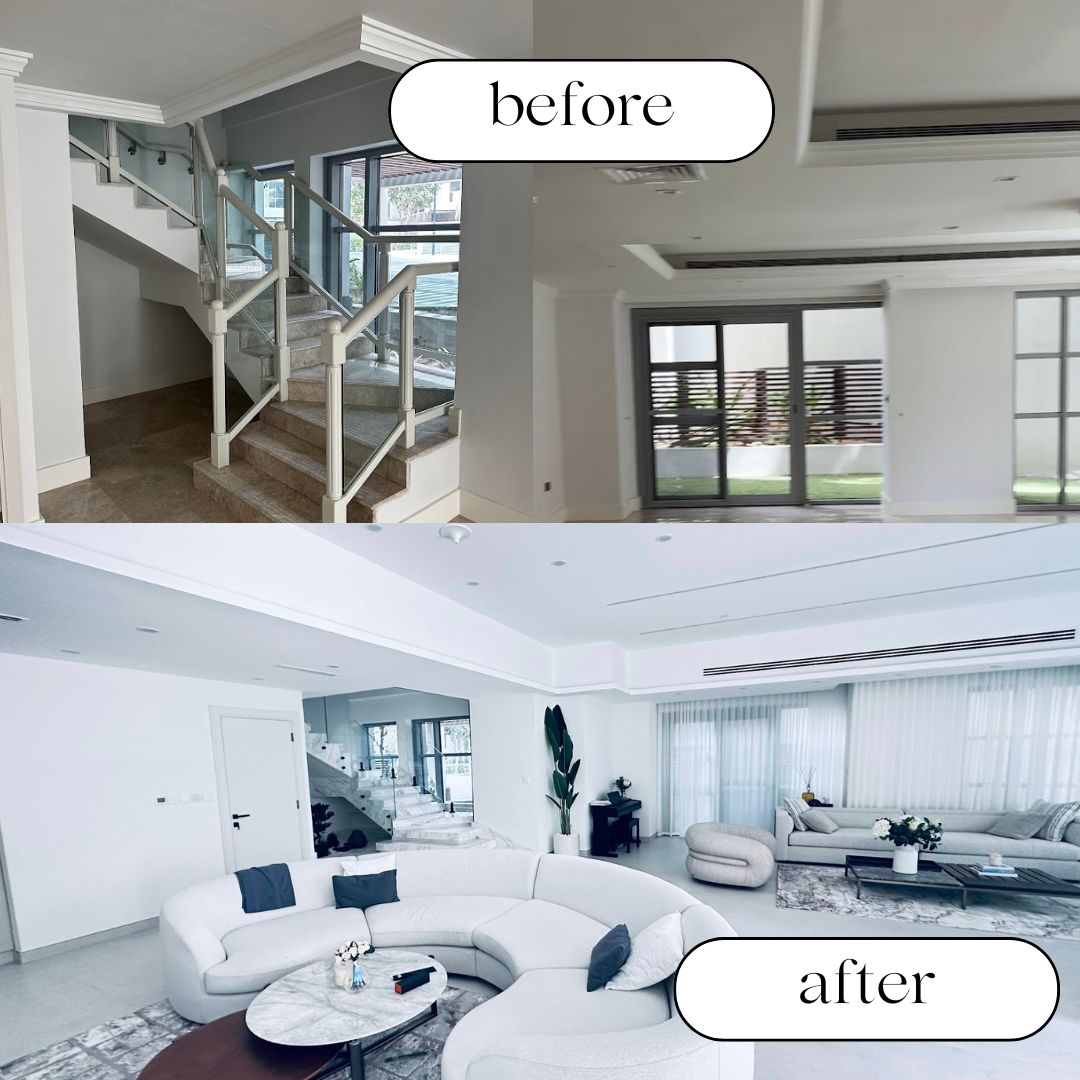
Dubai living room shown before renovation and after a bright contemporary cosmetic transformation
Light

Cosmetic Refresh

For a property whose layout and services are fundamentally sound. The emphasis is on paint, flooring, lighting, hardware, curtains, selected joinery updates and furniture rather than demolition-heavy work.

Keep layoutReuse sound elementsFast visual impactLower disruption
Bathroom before and after renovation from a basic tiled layout to a marble-look bathroom with floating vanity and freestanding tub
Targeted

Kitchen + Bathroom Renovation

For service-heavy rooms where cabinetry, sanitaryware, waterproofing, plumbing, electrical, tiling, extraction and lighting need coordinated replacement. Keeping major wet points in place can protect both budget and programme.

WaterproofingMEP coordinationCabinetry / sanitarywareSame-layout savings
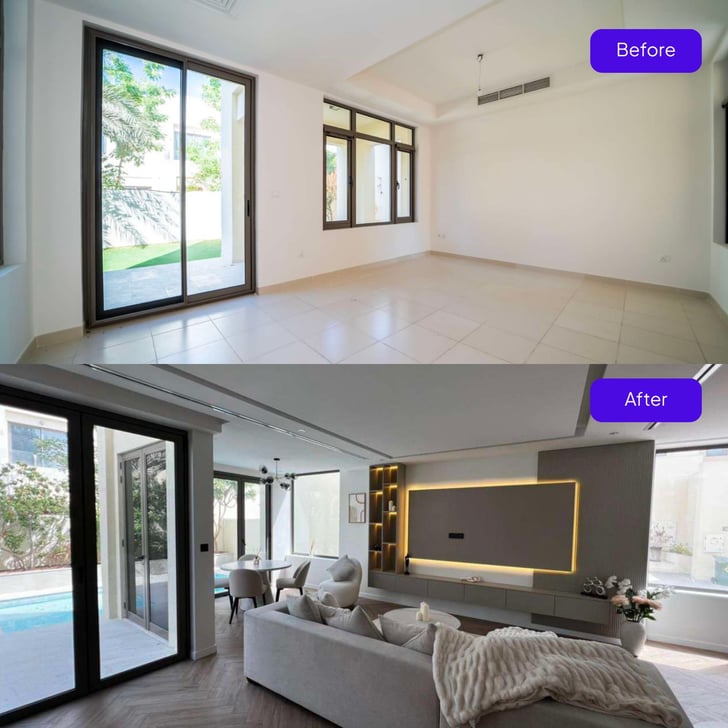
UAE townhouse living room before renovation and after new flooring, media wall, lighting and furniture
Reconfiguration

Apartment Interior Renovation

For apartments that need better circulation, storage, kitchen integration, lighting or a more contemporary finish while working around building shafts, service lifts, access times and fixed structural elements.

Space efficiencyBuilding logisticsFixed service shaftsNoise / access restrictions
UAE luxury villa renovation site with contractors reviewing large drawings beside staircase and glazing
Deep

Full Villa Renovation

For properties where several systems and rooms must be upgraded together: layout, MEP, ceilings, wet areas, flooring, kitchens, bathrooms, doors, joinery, lighting and finishes. This scope needs a proper pre-construction phase and realistic contingency.

Whole-home sequencingMEP renewalStructural / approval reviewLong-lead procurement

What Interior Renovation Can Include

Strip out only what the approved scope is ready to rebuild.

The exact package is based on the existing property. A renovation quotation should identify demolition, hidden works, finishes, fixtures, approvals and exclusions separately enough that you can understand where the budget is going.

01

Survey + existing-condition review

Understand the property before opening it up.

  • Measured plan / existing drawing review
  • Wall / column / shaft identification
  • Ceiling and MEP condition review
  • Existing kitchen / bathroom assessment
  • Door / window / flooring condition
  • Retain / remove / repair schedule
02

Demolition + enabling works

Remove in a controlled sequence and protect what remains.

  • Floor / wall / ceiling strip-out
  • Kitchen / joinery dismantling
  • Sanitaryware / fixture removal
  • Non-structural partition demolition where approved
  • Debris handling / protection
  • Temporary services / isolation where required
03

MEP + concealed upgrades

Fix what will disappear behind the finishes.

  • Electrical rewiring / new circuits
  • Lighting and smart-home containment
  • Plumbing supply / drainage alterations
  • HVAC / diffuser / thermostat modifications
  • Data / AV infrastructure
  • Fire / life-safety interfaces where applicable
04

Wet areas + kitchens

Treat waterproofing and services as the priority layers.

  • Bathroom re-waterproofing
  • Shower falls / drainage
  • Sanitaryware and brassware
  • Kitchen cabinetry / appliances
  • Worktops / splashbacks
  • Extraction / power / plumbing coordination
05

Architectural finishes + joinery

Rebuild the visible interior after the concealed work is ready.

  • Gypsum partitions / ceilings
  • Flooring and skirting
  • Wall tiling / stone / decorative finishes
  • Doors and ironmongery
  • Built-in storage / media / wardrobes
  • Painting and final surface finishing
06

Completion + handover

Close the project systematically rather than simply stopping construction.

  • Final fixture installation
  • Lighting / controls setup
  • Joinery adjustments
  • Snagging / rectification
  • Deep clean / protection removal
  • Handover records / warranties where included

The renovation scope should state whether appliances, loose furniture, curtains, artwork, authority fees, landlord / developer deposits, temporary accommodation, storage, utility upgrades and unforeseen concealed defects are included or excluded.

The Renovation Sequence

Do not close the wall before the work inside it has been checked.

Your source brief correctly treats renovation as a phased process. Bella expands that sequence into seven practical stages so procurement, approvals and final close-out are not left outside the construction programme.

01

Plan + design

We define objectives, inspect the existing space, develop the layout and identify which elements stay, move or disappear. Structural / specialist questions are escalated before demolition drawings are finalised.

Approved renovation design + scope
02

Budget + approvals

The works are priced against a defined specification, contingency is set for unknown existing conditions and the required landlord / developer / authority route is confirmed before mobilisation.

Approved budget + permit / NOC plan
03

Protect + demolish

Common areas and retained finishes are protected, services isolated as required and demolition is limited to the approved strip-out scope so the contractor does not create unnecessary reinstatement.

Cleared / exposed renovation site
04

Structural + first-fix MEP

Approved wall changes, electrical, plumbing, HVAC, data and other concealed infrastructure are completed while access is still open. Required inspections / tests happen before closure.

Completed concealed works
05

Waterproof + close + finish

Wet areas are prepared and tested, partitions / ceilings closed, flooring and tiling installed, surfaces prepared and major fixed finishes completed.

Finished architectural shell
06

Joinery + fixtures + trim-out

Kitchens, wardrobes, doors, sanitaryware, switches, decorative lights, appliances and other final components are installed and adjusted against the finished dimensions.

Operational completed interior
07

Snag + test + hand over

Defects are recorded and closed, systems and controls checked, the site is cleaned and agreed warranties / manuals / completion records are handed over.

Renovation handover

Renovation Constraints You Cannot See in a Mood Board

The existing slab, shaft, ceiling void and drainage stack often decide what the new plan can do.

These are the conditions we test before turning a design idea into demolition instructions.

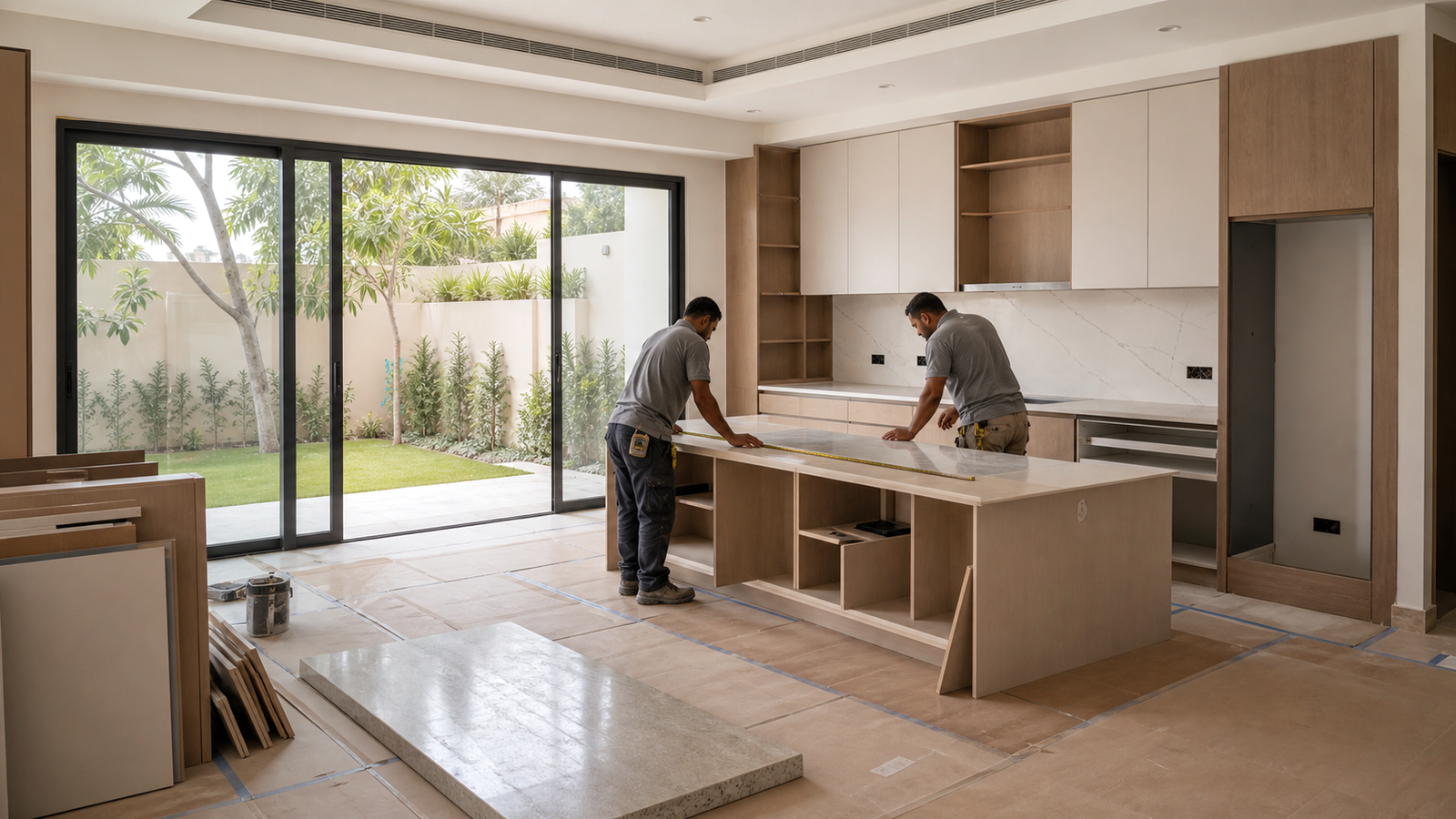
UAE contractors measuring a new kitchen island during a villa renovation with cabinetry and MEP work in progress
01

Do not assume a wall can be removed

Columns, shear walls, beams and post-tensioned slabs need to be treated as structural until the appropriate project information or engineer confirms otherwise. Even a non-load-bearing wall can contain electrical, plumbing, HVAC or fire-life-safety services that affect the cost of opening the plan.

02

Keeping wet fixtures near existing drainage can save major work

Moving a toilet, shower or kitchen sink far from the existing soil / waste stack can require additional floor build-up, drainage falls and approvals. If the goal is value rather than a total reconfiguration, keeping the wet footprint is often one of the strongest savings available.

03

Waterproofing is a concealed finish with visible consequences

Bathrooms and wet areas should be stripped to sound substrate where required, correctly waterproofed and tested before tile conceals the work. The expensive failure is rarely the tile itself—it is water reaching the slab, wall or neighbouring property behind it.

04

Opening walls can expose the real electrical and plumbing condition

Renovation budgets should carry contingency because existing cable routes, junctions, corroded valves, pipe repairs or undocumented modifications may only become visible after strip-out. These should be photographed and recorded before being covered again.

05

Changing the layout can change the AC behaviour

Removing partitions, closing rooms or adding large joinery can alter air distribution. Diffuser locations, return-air paths, thermostats and FCU / duct access should be coordinated with the new room arrangement rather than copied blindly from the old ceiling.

06

Apartment logistics can become a programme item

Service-lift booking, loading windows, noisy-work periods, contractor access, common-area protection and debris routes can determine how much work is physically possible in one day. Confirm the building’s fit-out manual before committing to an aggressive programme.

07

Joinery should be measured after the relevant construction is stable

Final kitchen, wardrobe and stone dimensions are safer after walls, floors and critical service points are established. Releasing custom fabrication only from the original developer drawing risks site gaps, clashes and expensive remakes.

08

The cheapest renovation keeps useful work in place

Retaining sound doors, flooring, sanitaryware, cabinet carcasses or appliances can be more economical than replacing everything. We assess the condition and visual impact, then concentrate spend on the changes that solve the actual problem.

Abu Dhabi Renovation Approvals

A renovation can be 'minor' and still sit inside a formal approval process.

DMT introduced a streamlined Abu Dhabi procedure in August 2025 that allows contractors to obtain approvals directly for specified minor works on eligible residential properties. The published scope includes non-structural interior / exterior modifications, general maintenance and interior finishes as well as certain small extensions, pools, canopies and fence works. That is useful for renovations, but it does not mean every alteration is automatically covered by the simplified route.

Where the renovation affects structure, MEP, fire / life-safety systems, façades, major openings or other regulated elements, the project can require additional consultant, landlord / developer or authority processes. We identify those interfaces during design so the contractor is not discovering the approval requirement after demolition.

  • What Abu Dhabi jurisdiction / community applies to the property?
  • Is the proposed work cosmetic, non-structural or structural?
  • Are walls, openings or room uses changing?
  • Are kitchen / bathroom drainage points moving?
  • Are electrical distribution, HVAC or plumbing systems being materially changed?
  • Are smoke detectors, sprinklers, emergency systems or rated partitions affected?
  • Does the developer / building require an NOC, contractor registration or deposit?
  • Are work-hour / service-lift / debris rules documented?
  • Which drawings must be submitted and by whom?
  • What inspections / completion documents are required before occupancy?
Read the current DMT — Streamlined Permit Process for Minor Works in Abu Dhabi
Kitchen renovation in progress with timber cabinetry, marble-look stone, finish samples, tools and drawings

Renovation Palettes That Work With Existing Conditions

A renovation palette should connect the new work to the parts of the property you are keeping.

Renovation is different from an empty-shell project because existing stone, windows, doors, furniture or fixed joinery may remain. We use those retained elements as part of the palette instead of selecting colours in isolation.

The HEX values below are Bella concept references adapted from the supplied research. They are not Sherwin-Williams, Benjamin Moore or other manufacturer paint codes; final paint and materials should be approved from the actual supplier samples.

Warm Minimal Renovation — alabaster #F2EFE9, accessible beige #D1C7BD, warm taupe #8A7E72, charcoal #3F3F40, natural oak #B99F82Organic Refresh — creamy white #F1EFE6, sage #9A9E8F, deep olive #4E534C, terracotta #B0745A, smoked timber #67584CHigh-Contrast Contemporary — clean white #F4F6F4, light greige #D5D2CD, deep navy #333941, black #2F2F30, warm metal #9B8066Soft Stone Apartment — chalk #F6F3EE, limestone #D8D0C5, mushroom #AAA096, muted teal #647A78, walnut #59483BModern Classic Villa — ivory #F7F3EB, warm stone #C8BCAF, muted blue #687783, bronze #8D7358, espresso #3D332DUse 60-30-10 or 70/30 as flexible visual guides only; existing architecture and retained finishes may require a different balanceFor bathrooms, approve tile together with grout, sanitaryware, metal finish and lighting because a small room magnifies undertone mismatchesFor kitchens, approve the cabinet finish beside the worktop / splashback and actual appliance colour before manufacturing doors

Renovation Cost & Programme

Price the depth of work—not just the number of rooms.

Current 2026 UAE renovation guides vary sharply because a 'renovation' can mean repainting an existing layout or stripping a villa back to its services. A September 2026 Dubai villa guide publishes a broad AED 40–320/sq ft range and says many full renovations fall around AED 95–160/sq ft. Another August 2026 dataset places full-renovation rates for independent mainland Dubai villas around AED 195–325/sq ft, rising substantially in premium communities where access, NOCs and specification are different. In Abu Dhabi, one current villa contractor publishes whole-villa renovation from AED 320,000, while another local provider publishes indicative full-villa budgets from AED 150,000. These are third-party feasibility references—not Bella prices, and the scopes are not directly comparable.

2026 room / component references

The rooms with water, services and custom joinery usually cost the most.

  • Dubai kitchen renovation — current guides range from roughly AED 40,000–150,000+ for many full renovations, with premium / fully bespoke projects extending to AED 250,000–500,000+
  • Standard bathroom — current 2026 Dubai guides commonly place a full standard bathroom around AED 25,000–50,000
  • Premium master bathroom — roughly AED 50,000–120,000+ in several current market guides, with highly bespoke stone / sanitaryware projects higher
  • Cosmetic room refresh — usually driven by paint, flooring, lighting and furniture rather than an AED/m² construction rate
  • Wall removal / reconfiguration — price depends on structural review, services within the wall and the amount of floor / ceiling / joinery reinstatement
  • Custom kitchen / wardrobes — cabinetry, hardware, internal accessories and stone can become one of the largest renovation allowances
  • MEP upgrades — existing condition, electrical capacity, AC and plumbing determine whether they are minor relocations or major replacement
  • Approvals / NOCs / deposits — property-specific and should be shown separately from the physical construction scope
  • Temporary accommodation / storage — should be carried by the client when kitchens, main bathrooms or whole-home services will be unusable
  • Contingency — existing-property projects commonly benefit from a defined contingency for concealed conditions rather than spending the full budget at contract award
Planning references

A refresh can take weeks; a reconfigured whole home can take months.

  • Cosmetic refresh — often about 1–3 weeks once selections and access are ready
  • Single bathroom — current Dubai sources commonly publish around 2–4 weeks on site depending on strip-out, waterproofing and material scope
  • Kitchen renovation — current 2026 sources publish roughly 3–5 weeks for many standard kitchens, while deeper bespoke reworks can run 6–16 weeks
  • Standard multi-room renovation — typically several weeks once design, NOCs and procurement are complete
  • Whole-villa renovation — current UAE project sources commonly publish programmes from roughly 4–10 weeks for limited / coordinated scopes to several months for deeper full-home work
  • Full remodel / structural reconfiguration — design, approvals, structural / MEP works and imported items can push the total programme to 3–6+ months

A 'four-room renovation' is not a standard UAE pricing unit. Four rooms can mean four bedrooms, four total rooms, or a property with multiple kitchens / bathrooms. For a useful estimate, provide floor area, room list, wet-area count, layout changes, MEP scope and finish level. Compare every quote on the same inclusions, exclusions and VAT basis.

Interior Renovation Questions, Answered Clearly

Interior Renovation — Frequently Asked Questions

These answers separate cosmetic work from deeper remodeling and explain the UAE cost, approval and sequencing questions clients usually need resolved before they start.

01What is an interior renovation?

An interior renovation improves an existing property by repairing, replacing or reconfiguring its interior elements. It can range from paint, flooring and lighting to new kitchens, bathrooms, partitions, ceilings, electrical, plumbing, HVAC, waterproofing and custom joinery. The defining feature is that new work has to integrate with an existing building.

02What comes under renovation?

Depending on scope, renovation can include survey, demolition, partitions, MEP alterations, waterproofing, ceilings, flooring, tiling, kitchens, bathrooms, doors, joinery, painting, lighting, smart-home interfaces, furniture and final snagging. Structure, façades, pools or major services can require additional specialist / approval scopes.

03What is the difference between a refresh, renovation and remodel?

A refresh changes mostly visible finishes and furnishings. A renovation replaces worn or outdated parts while broadly retaining the room structure. A remodel changes the way the property is configured—for example removing walls, relocating a kitchen or materially altering plumbing / MEP. The deeper the intervention, the more design, approvals and contingency are normally required.

04How can I renovate my room?

Start by identifying what is actually wrong: layout, storage, lighting, finish condition or furniture. Measure the room, decide what stays, set a budget, resolve the layout, choose finishes and lighting, then schedule works in sequence. If walls, plumbing, ceilings or electrical points are changing, get the technical and approval route checked before demolition.

05What is the cheapest way to renovate a room?

Keep the existing layout and useful fixed elements. Repaint, refinish or reface rather than replace sound cabinetry, retain plumbing locations, update lighting / hardware, repair existing flooring where practical and spend on one or two high-impact elements. Moving wet services and demolishing sound work are usually poor ways to save money.

06What is the average cost of renovating a house in Dubai in 2026?

There is no single reliable average because current guides use very different scopes. One September 2026 villa guide publishes AED 40–320/sq ft overall and says many full renovations sit around AED 95–160/sq ft. Another current dataset places full renovation of independent mainland villas around AED 195–325/sq ft. Compare the exact work included before using either number.

07How much does villa renovation cost in Abu Dhabi?

Current Abu Dhabi contractor references also vary. One provider advertises full-villa renovation from AED 320,000, while another publishes indicative projects from AED 150,000. Those starting figures do not describe the same villa size or specification. The useful budget comes from floor area, MEP condition, kitchens / bathrooms, wall changes, joinery and finish level.

08How much is a four-room renovation?

Four rooms is not a standard UAE cost category. It may mean four bedrooms plus living areas, or four rooms total. A meaningful estimate needs the property area, room list, number of kitchens / bathrooms, layout changes, MEP scope and finish level. Room count by itself can understate a renovation dramatically.

09How much does a kitchen renovation cost in Dubai?

Current 2026 guides vary by specification. Several publish common full-kitchen ranges around AED 40,000–150,000+, while bespoke kitchen projects can reach AED 250,000–500,000+. The largest variables are cabinetry, worktops, appliances and whether plumbing, gas / extraction, electrical or the room layout moves.

10How much does a bathroom renovation cost in Dubai?

Current 2026 guides commonly place a standard full bathroom around AED 25,000–50,000 and premium master bathrooms around AED 50,000–120,000+, although published ranges vary. Waterproofing, tiling, sanitaryware, drainage relocation and custom vanity / stone drive the price.

11What is the 70/30 rule in interior design?

It is a flexible styling guideline, not a construction rule. A common interpretation is to let about 70% of the scheme follow one anchor style and use about 30% for contrast or another influence. During renovation it can help blend retained elements with new ones, but there is no need to calculate the room literally.

12Do I need approval for interior renovation in Abu Dhabi?

It depends on the work. DMT's streamlined minor-works route covers specified non-structural interior modifications, maintenance and interior finishes for eligible residential properties. Structural, MEP, fire-life-safety or other deeper alterations can require additional consultant, developer / landlord or authority processes.

13Can I remove an internal wall during renovation?

Only after confirming what the wall is and what runs through it. A wall can be structural or contain electrical, plumbing, HVAC or fire-related services. The design and contractor team should verify the condition and required approval before issuing demolition instructions.

14Should I keep the existing plumbing locations to save money?

Often, yes. Keeping toilets, showers, sinks and kitchen services close to existing stacks can reduce floor breaking, drainage changes, approvals and reinstatement. Move them when the functional benefit justifies the added work, not simply because the new mood board shows a different location.

15How long does an interior renovation take?

A cosmetic room refresh may take one to three weeks; a bathroom often takes roughly two to four weeks on site; a standard kitchen often around three to five weeks; deeper bespoke kitchens and multi-room renovations take longer. Whole-home structural / MEP renovation can run several months after design and approvals.

16Can I live in the property during renovation?

Sometimes for a phased cosmetic project, but it becomes difficult when the main kitchen, bathrooms, AC, electrical supply or several rooms are unavailable. Dust, noise, worker access and protection also matter. For a deep renovation, temporary accommodation is often safer and can let the contractor work more efficiently.

17What are the best renovation services in Dubai?

Rather than relying on a generic 'top 10' list, compare firms by the type of property they have actually renovated, valid trade activity / contractor capability, detailed BOQ, approvals experience, MEP depth, waterproofing method, programme, variation rules, warranty, supervision and recent completed projects similar to yours.

18What is the cheapest villa in Dubai?

There is no stable answer because active property listings and asking prices change continuously, and 'cheapest' often means a different community, lease status, plot or condition. If the question is really about buying a low-cost villa to renovate, compare purchase price plus NOCs, structural / MEP condition and renovation cost—not the listing price alone.

Tell Us What You Want to Change—and What You Want to Keep

The existing property is part of the brief.

Share the location, property type, floor area, age / condition if known, rooms you want to renovate, what you want to retain, whether walls or wet areas may move, approximate budget and required completion date.

Attach the existing floor plan, developer / landlord information, site photos, inspection reports, contractor quotations or previous renovation drawings if you have them. The more we know about the existing property before demolition, the more useful the first scope and budget discussion will be.