Private Jet Interior Design in Abu Dhabi

Aircraft & Private Jet Interior Design Abu Dhabi

If you are acquiring a pre-owned aircraft, refreshing a cabin during an Abu Dhabi maintenance visit, developing a family or corporate VIP interior, or shaping a larger BBJ / ACJ concept, Bella can lead the design brief from cabin planning and material direction through visualization, upholstery, carpet, veneer, plating, lighting and completion-centre coordination. For planning only, established large-cabin benchmarks place seat re-covering around AED 734,500, carpet replacement around AED 146,900–330,500 and wood refinishing around AED 1.10–1.84 million; current 2026 market commentary says full interior + exterior refurbishment programmes on large aircraft commonly average about AED 5.51–22.04 million. These are external market references, not Bella quotations, and certification-heavy VVIP programmes can cost materially more.

Abu Dhabi has real aviation infrastructure around this work. Al Bateen Executive Airport (AZI) is the capital's dedicated business-aviation airport, operating 24/7 with stand capacity for more than 50 private jets. Falcon Engineering at Al Bateen publishes cabin-interior overhaul capability in cooperation with approved partners, while Etihad Airways Engineering beside Zayed International Airport provides cabin refurbishment, configuration, major modification capability and onsite flammability testing. Bella's role is to represent the owner's design intent and coordinate it into that regulated technical chain without pretending ordinary interior-design drawings are approved aircraft engineering.

Private Jets + Business JetsAl Bateen / AZIZayed International / AUHCabin RefurbishmentVIP + VVIP InteriorsDesign + Completion Coordination
Airbus ACJ TwoTwenty wide-cabin private jet lounge with dining table, executive seating, broad aisle and integrated ceiling lighting
Private Aviation / Abu Dhabi Mission · Cabin Zoning · Certified Materials · Coordination

Start With the Aircraft, Registry and Abu Dhabi Work Scope

What do you need the cabin to do—and what is the aircraft actually approved to change?

A private jet interior project in Abu Dhabi can mean new leather and carpet during a maintenance slot, a complete visual refurbishment, a new cabin-management package, or a major reconfiguration affecting seats, partitions and monuments. Those are not the same project. Before we design, we need the aircraft type, registry, current approved layout, typical mission, passenger profile, maintenance location, desired changes and target redelivery date.

01

You have bought a pre-owned jet and the cabin feels dated

We identify what can create the largest visual change without automatically turning the project into a major reconfiguration. Leather, carpet, selected sidewall and headliner finishes, decorative plating, veneer refinishing and loose soft goods can transform a cabin while preserving more of the existing approved geometry.

02

You want to combine cabin work with an Abu Dhabi maintenance event

That can be efficient when the design package, material approvals, engineering and seat or monument work are prepared before the aircraft enters the hangar. Al Bateen and the wider Abu Dhabi aviation ecosystem provide real local maintenance and cabin capability, but the exact facility must be matched to the aircraft type and approved scope.

03

You want a villa- or yacht-level atmosphere without residential construction weight

We translate the feeling rather than copying residential construction literally. Rich veneer, woven texture, stone appearance, tailored upholstery, layered carpet, concealed storage and warm lighting can be developed through lightweight aviation-suitable constructions for technical review by the appointed aviation specialists.

04

Your aircraft has to work as office, dining room, lounge and bedroom

Long-range missions demand zoning. Gulfstream positions the G700 with up to five living areas, while Airbus describes the ACJ TwoTwenty around six cabin zones. We use that mission logic—work, lounge, dining, private suite, service and crew functions—only as a planning reference; your actual airframe and approved configuration remain the starting point.

05

You want an Abu Dhabi owner identity without turning the cabin into a theme

A majlis-inspired social zone, stronger family privacy, formal hosting, prayer-space flexibility, refined Arabic material cues or a quieter executive palette can be incorporated where appropriate. RoyalJet's Abu Dhabi fleet provides a local example of VVIP cabins using majlis lounges, private suites, premium veneers, lighting and advanced cabin systems.

06

You want to move seats, partitions, monuments or systems

That is no longer purely decorative. GCAA guidance treats changes such as cabin reconfiguration, seat-layout changes, new galleys, toilets and certain systems as changes requiring approved design and substantiating data. Bella develops design intent; the approved Design Organisation / OEM / STC holder and maintenance organisation determine what can be certified and released.

Why Abu Dhabi Matters for Private Jet Interior Projects

The capital combines business aviation, VVIP operating experience and cabin engineering—but the responsibilities still have to stay clear.

A strong aircraft-interior programme is a coordinated chain: owner, interior designer, technical representative, operator / CAMO, approved engineering organisation, MRO or completion centre, seat and monument specialists, material suppliers and authority. Bella works on the design side of that chain and helps keep the visual brief coherent as technical decisions are made.

01

1. Al Bateen Executive Airport / AZI

Al Bateen is Abu Dhabi's dedicated business-aviation airport. Abu Dhabi Airports states that it operates 24/7, has stand capacity for more than 50 private jets, a 3,202-metre runway, secure hangar and apron parking, and a new 2,200 m² VVIP facility. For owners and operators, that makes Al Bateen a natural point for business-aviation coordination in the city.

  • AZI
  • Business aviation
  • Private-jet stands
  • Hangar / apron
  • VVIP facilities
02

2. Cabin overhaul capability at Al Bateen

Falcon Engineering publishes aircraft-interior servicing and cabin-overhaul capability from its Al Bateen base, working with approved partners and Part 21J design offices. Its published approvals include GCAA 145, GCAA CAMO and EASA Part 145. That is useful local context, but the exact aircraft type and project scope still need formal capability confirmation before appointment.

  • Falcon Engineering
  • GCAA 145
  • CAMO
  • Cabin overhaul
  • Design-office coordination
03

3. Zayed International Airport / AUH engineering ecosystem

Etihad Airways Engineering, adjacent to Zayed International Airport, publishes cabin maintenance, repair, overhaul, refurbishment and configuration capability, including major cabin modifications under EASA Part 21J and onsite flammability testing. For projects operating through AUH, that gives Abu Dhabi substantial cabin-engineering infrastructure beyond private-jet handling alone.

  • AUH
  • Cabin refurbishment
  • Part 21J
  • Flammability testing
  • Backshop capability
04

4. VVIP cabin culture is already visible locally

RoyalJet's Abu Dhabi fleet demonstrates how private-aviation interiors can combine formal hospitality, majlis-style lounge zones, private staterooms, galleys, showers, advanced IFE / CMS and long-range comfort. We use such local examples as evidence of what the regional owner experience can demand—not as a claim that Bella designed those aircraft.

05

5. Mission profile before material palette

A two-hour GCC sector, an overnight Europe mission and an ultra-long-range intercontinental flight create different priorities. Passenger count, crew use, meetings, dining, sleep, family privacy, luggage and resale strategy should determine how the cabin is zoned before a leather or veneer sample is selected.

06

6. Certification before layout ambition

Registry, type certificate, existing STCs, approved seating, monument locations, emergency egress and installed systems determine the engineering route. A visually simple request can have major technical consequences if it touches certified seats, emergency exits, electrical systems or structural attachments.

07

7. Owner reviews can happen across Abu Dhabi—not only at the hangar

Design meetings, sample reviews and owner approvals can be coordinated around Al Bateen, ADNEC / Al Rawdah, the Corniche, Al Maryah Island, Al Reem Island, Saadiyat Island, Yas Island, Al Raha Beach, Khalifa City and other Abu Dhabi business or residential locations, while physical aircraft work remains subject to the appointed aviation facility and access controls.

Aircraft Types & Cabin Programmes

Private jet interior design in Abu Dhabi changes with the airframe, approved layout and mission.

There is no responsible one-size-fits-all 'luxury jet package'. Cabin width, seat tracks, exits, existing monuments, systems, certification basis and the owner's mission determine what is realistic. The examples below describe design logic—not permission to modify a particular aircraft.

Compact private business jet cabin with tan leather executive seats, wood-finish side ledges and narrow central aisle
Aircraft / 01

Light & Midsize Jet Cabin Refresh

Citation, Phenom, Learjet and comparable cabins demand visual discipline because club seating, tables, storage, galley and lavatory functions share a tight fuselage. We concentrate the palette, reduce unnecessary material transitions and use seat, carpet, sidewall and ledge detailing to make the cabin feel calmer without stealing usable aisle width.

Seat upholsteryCarpetSidewall / headlinerCompact storageVisual width
Private aircraft executive club seating around a polished table beside large cabin windows and integrated side ledges
Aircraft / 02

Super-Midsize Executive Jet

Praetor, Challenger and comparable super-midsize aircraft can support more generous club groups, a divan, work / conference surfaces and stronger storage, but the cabin remains sensitive to visual mass. We coordinate seating, credenza, window-side surfaces, lighting and materials as one continuous interior rather than treating each item separately.

Club seatingDivanConference / workCredenzaLighting scenes
Gulfstream G700 large-cabin interior with cream leather seating, wood bulkheads, panoramic windows and long central aisle
Aircraft / 03

Large-Cabin & Ultra-Long-Range Jet

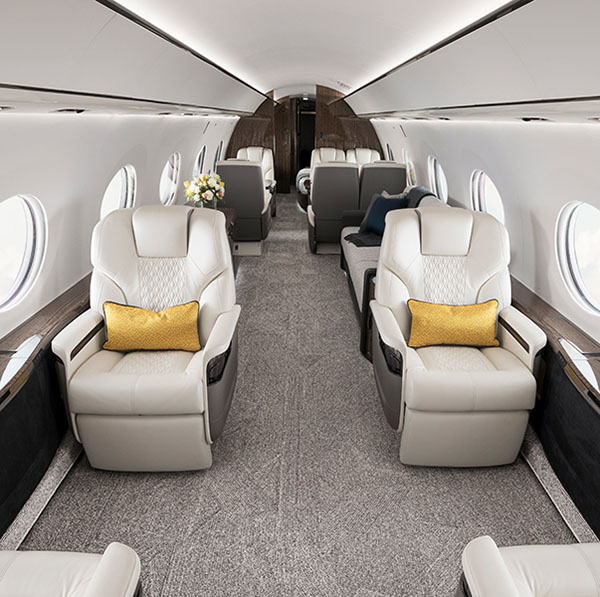
Gulfstream, Global, Falcon and comparable long-range aircraft allow true zoning: club, lounge, conference / dining, sleep and private areas can form a sequence instead of one repeated seat arrangement. That makes the project closer to compact interior architecture—while every component still lives inside certified aircraft constraints.

Multi-zone planningDining / conferencePrivate suiteLong-haul comfortConnectivity
Airbus ACJ TwoTwenty wide VIP cabin with dining table, lounge seating, broad aisle and layered ceiling lighting
Aircraft / 04

BBJ / ACJ & VVIP Airliner Interior

Corporate airliners allow formal reception, conference and dining spaces, private staterooms, large lavatories, crew areas and highly developed hospitality. Airbus describes the ACJ TwoTwenty around 73 m² of floor area split into six zones, while RoyalJet's Abu Dhabi BBJ fleet shows the regional relevance of majlis lounges, private bedrooms and long-range VVIP functions.

Reception / majlisFormal diningPrivate suiteCrew / serviceMulti-zone privacy
Premium aircraft cabin interior with leather seating, integrated display, cabinetry and privacy partition shown by Etihad Airways Engineering in Abu Dhabi
Aircraft / 05

Pre-Owned Cabin Refurbishment in Abu Dhabi

A pre-owned aircraft often does not need a new floorplan to feel new. Seat leather, carpet, cabinetry finish, plated hardware, sidewalls, headliner, curtains and lighting can be coordinated into a single design language. We help you decide what is worth retaining, what visibly ages the aircraft, and what should be renewed while the technical team checks approved materials and installation requirements.

Retain what worksSeats + carpetVeneer / platingSidewalls + ceilingResale awareness
RoyalJet Boeing Business Jet floor plan showing VVIP lounge, club seating, private stateroom, galley and lavatory zoning
Aircraft / 06

Owner Fleet / Charter Cabin Harmonisation

Family offices, corporations and operators with more than one aircraft may want a recognisable visual identity without forcing identical layouts. We can align leather families, stitching, carpet geometry, veneer tone, metal finish, lighting temperature, soft goods and branded touches while each airframe retains its own approved configuration and maintenance strategy.

Fleet identityRepeatable finishesSpare materialsCharter durabilityResale flexibility

Aircraft Interior Design Scope in Abu Dhabi

Bella owns the design brief; approved aviation organisations own the engineering and airworthiness release.

That distinction protects the project. We can define what the cabin should look and feel like, develop layouts and visualization for design discussion, specify candidate finishes and coordinate the owner decisions. The aircraft's authorised technical organisations decide what can be embodied, certify the change and return the aircraft to service.

01

Aircraft + owner mission brief

Define the mission before the material palette.

  • Aircraft make / model / serial
  • Registry and operator
  • Existing approved cabin layout
  • Typical passenger count
  • Typical sector length
  • Corporate / family / charter use
  • Meeting and work needs
  • Dining and catering expectations
  • Sleep and privacy requirements
  • Wardrobe / luggage needs
  • Resale / fleet strategy
  • Target maintenance and redelivery slot
02

Abu Dhabi aviation + stakeholder coordination

Plan where owner reviews happen and where the aircraft will physically be worked on.

  • Al Bateen Executive Airport / AZI
  • Zayed International Airport / AUH
  • Falcon Engineering / selected Al Bateen MRO capability
  • Etihad Airways Engineering / selected cabin capability
  • Owner / operator technical representative
  • CAMO / continuing-airworthiness coordination
  • Hangar slot timing
  • Material and sample logistics
  • Security and aircraft-access rules
  • Owner meetings across Al Bateen, Saadiyat, Yas, Al Maryah, Al Reem, Al Raha and Khalifa City
03

Cabin zoning + layout design intent

Use existing certified geometry intelligently before proposing expensive changes.

  • Executive club seating
  • Majlis-inspired social zone where appropriate
  • Conference / dining
  • Divan / relaxation
  • Private suite / sleeping zone
  • Crew-rest interface
  • Galley
  • Lavatory
  • Credenza / media
  • Wardrobe / storage
  • Privacy partitions
  • Prayer-space flexibility where feasible
04

Colour + aviation-material direction

Candidate finishes are chosen for appearance first and then taken through the required technical qualification route.

  • Leather / approved upholstery
  • Carpet
  • Veneer / decorative face
  • Technical laminates
  • Decorative plating
  • Lightweight stone or stone-look concepts
  • Solid-surface concepts
  • Headliner and sidewall textiles
  • Curtains and window treatments
  • Seat stitching / perforation
  • Loose soft goods
  • Material sample boards
05

Lighting, CMS, IFE + user-experience intent

Technology should feel designed into the cabin rather than bolted on after the visual package is frozen.

  • Ambient lighting scenes
  • Reading and task light intent
  • Cabin Management System interface points
  • IFE screen integration
  • Wi-Fi / connectivity coordination
  • Charging / power access
  • Motorised shades
  • Audio-zone planning
  • Control-panel visibility
  • Night-flight scene hierarchy
06

Visualization + completion coordination

Give the owner and technical team the same visual target before fabrication starts.

  • Mood and reference boards
  • Cabin-zone plans for design discussion
  • 3D renderings
  • Material schedules
  • Seat / divan visual concepts
  • Carpet design
  • Veneer and plating direction
  • Galley / lavatory visual concepts
  • Supplier sample review
  • Design responses to technical comments
  • Aesthetic inspection / snagging
  • Redelivery styling and documentation support

Bella does not present itself as an aircraft Design Organisation, MRO, CAMO or certifying authority. Any modification, material approval, structural detail, electrical change, seat change or airworthiness release must be handled by the organisations legally authorised for the specific aircraft and registry.

Our Aircraft Interior Design Process

Freeze the owner decisions early enough for engineering, procurement and the hangar slot to work together.

Aircraft downtime is expensive. The design process therefore has to resolve subjective decisions—layout intent, colour, leather, carpet, veneer, plating, lighting and technology interfaces—before the aircraft is opened up whenever possible.

01

Aircraft + Mission Brief

We review aircraft model, registry, approved layout, ownership / operating profile, passenger mission, current condition, budget logic, Abu Dhabi maintenance plan and target redelivery.

02

Cabin Survey + Existing Data

Using available drawings, photographs, surveys, cabin inventory and technical information, we identify what stays, what changes and which requests need early technical review.

03

Concept + Zoning

We develop the owner experience: work, dining, lounge, sleep, service and privacy relationships, plus the visual language that connects those zones.

04

Early Engineering Check

Before design effort is wasted, major seat, monument, system, attachment or material ideas are referred to the appointed approved technical organisations for feasibility and certification direction.

05

Materials + Samples

Leather, textile, carpet, veneer, plating, decorative surfaces and soft goods are refined as physical or supplier samples, then routed for the required aviation compliance review.

06

3D + Owner Design Freeze

High-quality renderings and coordinated schedules allow the owner to approve the atmosphere, proportions and major visual decisions before fabrication and installation.

07

MRO / Completion Coordination

We answer design queries, review technically driven substitutions and help preserve the design intent as engineering, fabrication, seat work, systems and installation progress.

08

Aesthetic Inspection + Redelivery

We review visible workmanship, finish consistency, upholstery, carpet alignment, hardware, lighting scenes and styling issues, while the authorised aviation teams handle technical inspection and return-to-service documentation.

Aircraft Interior Technical Coordination

A private jet is not a villa with wings: every beautiful decision sits inside an airworthiness system.

The design can be luxurious, quiet and highly personal, but it must be developed around the certified aircraft. The items below are the interfaces we expect the approved technical team to review as the design progresses.

Aircraft passenger seats stripped for technical work during cabin modification at Etihad Airways Engineering in Abu Dhabi
01

Registry + certification basis

A UAE-registered aircraft follows GCAA requirements, while the state of design, accepted type certificate, existing STCs and approved data also shape the change route.

02

Seat layout + emergency egress

Moving certified seats, changing pitch, altering distance to partitions or changing access to exits can trigger design and certification work. A visually stronger layout is irrelevant if it conflicts with approved safety geometry.

03

Flammability + material qualification

Leather, fabrics, carpets, foams, laminates, veneers, adhesives and decorative constructions must follow the applicable aircraft material and flammability requirements. Etihad Engineering publishes onsite flammability-testing capability in Abu Dhabi.

04

Weight + balance

Every new material, monument and system adds or redistributes mass. Luxury should be achieved through construction intelligence, not residential thickness.

05

Monuments + structural attachment

Partitions, wardrobes, credenzas, galleys, lavatories and bespoke furniture are aircraft monuments with approved attachment, loads and access requirements—not freestanding residential joinery.

06

Electrical + CMS / IFE

Screens, lighting, charging, audio, connectivity, powered seats, shades and galley equipment affect power, wiring, heat and system architecture. The design intent has to be coordinated with approved engineering.

07

Lighting + environmental systems

Lighting scenes influence comfort, but fixtures, power and controls interact with aircraft systems. Sidewalls and ceilings also coexist with ventilation, oxygen, speakers, sensors and service panels.

08

Acoustics

Soft goods, insulation strategy, dividers and cabin systems affect perceived noise. Any acoustic construction proposed by the designer must fit the approved technical solution and weight target.

09

Galley + lavatory

Water, waste, electrical loads, appliances, fire protection, ventilation, storage and access make galleys and lavatories technically dense. Their visual treatment has to respect those systems.

10

Maintainability + removability

Panels, trim and decorative features should not block inspections, emergency equipment, access panels or routine maintenance. A beautiful detail that doubles maintenance time is rarely a successful aircraft detail.

11

Approved records + continuing airworthiness

Changes may affect drawings, equipment lists, maintenance instructions, weight-and-balance data, MEL implications or other records. Those documents belong to the approved technical and operator processes, not the decorative design package.

GCAA Approval & Airworthiness

When a cabin idea changes the approved aircraft, it needs an aviation approval route—not an interior-design sign-off.

GCAA CAR 21 guidance identifies cabin-layout changes, dynamically tested seat changes, seat-pitch changes, altered seat-to-divider distances, changes affecting evacuation paths, new galleys, toilets and wardrobes, and certain electrically powered galley equipment as examples that can require formal design assessment. That means 'move this seat' or 'add a partition' can be an engineering request even when it looks simple on a rendering.

For UAE-registered aircraft, GCAA guidance on approval / acceptance of changes and repairs says applications should include the design and substantiating data. It specifically notes interior cabin reconfiguration and avionics / in-flight-entertainment upgrading as examples where a complete data package may be required when a UAE-registered aircraft is used as the prototype for a change.

Bella therefore treats renderings, mood boards, cabin-zone plans and material concepts as design information. The appointed approved Design Organisation, OEM / STC holder, maintenance organisation, operator / CAMO and GCAA processes determine the final engineering, compliance evidence and release to service.

  • Confirm aircraft registry and accepted type certificate
  • Identify existing STCs and approved cabin configuration
  • Classify proposed changes with the approved design organisation
  • Confirm seat / monument / exit / egress implications
  • Confirm material and flammability requirements
  • Confirm electrical / CMS / IFE and antenna implications
  • Confirm weight-and-balance impact
  • Agree responsibility for approved design data
  • Agree maintenance / completion-centre scope
  • Plan updated records and return-to-service requirements
Read the current UAE GCAA — Approval / Acceptance of Changes and Repairs
Gulfstream G700 private sleeping suite with upholstered bed, neutral textiles, dark wood veneer, integrated lighting and panoramic windows

Private Jet Materials, Colours & Finishes

Luxury comes from proportion, restraint and material quality—not from adding residential weight to an aircraft.

Abu Dhabi owners often ask for the calm, material richness and hospitality of a high-end residence or majlis. In an aircraft, that character has to be achieved with lighter constructions, aviation-suitable substrates, controlled detailing and approved material systems.

We normally begin with one dominant architectural base, one secondary material family and a restrained accent hierarchy. That keeps a narrow cabin visually continuous while still allowing a private suite, conference zone or majlis-inspired lounge to feel distinct.

Abu Dhabi Contemporary — Warm Ivory #EEE9DF · Smoked Walnut #4A372E · Sandstone #C9B89D · Champagne Metal #B89A6AExecutive Majlis — Deep Mocha #3B2C27 · Camel Leather #B78355 · Pearl #F3EFE8 · Brushed Bronze #8C6B4FYas Night — Midnight Navy #1D293B · Pale Grey #D9DDE0 · Dark Walnut #352A24 · Cool Nickel #A9ADB1Saadiyat Light — Chalk #F3F0E8 · Driftwood #A9957B · Sage Grey #9A9E91 · Soft Brass #B29A6BUpholstery — aviation-qualified leather, technical leather or textile selected around seat approval, wear, cleanability and the applicable compliance routeCarpet — custom wool / wool-blend or another approved construction coordinated around aisle scale, pattern repeat, weight, edge finishing and cleaningVeneer — thin natural or engineered decorative face on lightweight aviation construction rather than heavy solid residential cabinetryPlating — nickel, chrome, bronze, champagne, gold-tone, gunmetal or other approved decorative systems coordinated with the component substrateStone appearance — thin stone, lightweight backed stone, approved engineered surface or simulated finish rather than conventional full-thickness slabHeadliner + sidewalls — lighter tones can visually widen the fuselage while deeper lower-sidewall finishes create a grounded, quieter cabinSoft goods — pillows, blankets, curtains and bedding coordinated for appearance, storage, cleaning and operator proceduresConcealed detail — flush latches, pocketed controls, integrated charging and discreet storage reduce visual clutter when approved hardware and systems allow it

Private Jet Interior Cost Abu Dhabi & Downtime

How much does a private jet interior cost in Abu Dhabi?

There is no credible single AED-per-square-foot rate for an aircraft cabin. Cost depends on aircraft class, what can be retained, certified seats and monuments, material qualification, systems, engineering, MRO labour, downtime and the level of owner customization. The figures below are external planning benchmarks converted at USD 1 = AED 3.6725, the Central Bank of the UAE's published USD rate on 2 October 2026. They are not Bella quotations.

External large-cabin refurbishment benchmarks

Use these numbers to understand scale before an Abu Dhabi aircraft-interior proposal is issued

  • Seat re-covering: Guardian Jet's large-cabin / ultra-long-range guide estimates about USD 200,000 for new leather on cabin seats — approximately AED 734,500.
  • Carpet replacement: the same guide estimates roughly USD 40,000–90,000 — approximately AED 146,900–330,500.
  • Woodwork refinishing: Guardian Jet gives roughly USD 300,000–500,000 — approximately AED 1.10–1.84 million.
  • Broader 2026 programme context: an aviation designer / project-oversight specialist writing for GlobalAir says full interior + exterior refurbishments she works on commonly average around USD 1.5–6 million — approximately AED 5.51–22.04 million. That figure includes exterior work and is not an interior-only rate.
  • A full VVIP BBJ / ACJ completion, major cabin reconfiguration, shower, new monuments, substantial CMS / IFE / connectivity or bespoke certified hardware can exceed these ranges materially.
  • Bella's design fee is quoted separately after the aircraft, cabin zones, 3D requirement, material development, owner-review process, travel, Abu Dhabi MRO / completion coordination and expected project duration are defined.
  • Do not compare aircraft design directly with villa interior-design rates. The visible square metres are small, but the engineering, approved components, material testing and aircraft-on-ground consequences are completely different.
Programme + downtime

The best way to protect aircraft downtime is to resolve owner decisions before the maintenance slot starts

  • Guardian Jet cites roughly 6–10 weeks for a large-aircraft soft-goods refurbishment and around 14–16 weeks of downtime for a complete refurbishment as industry benchmarks.
  • Current 2026 GlobalAir commentary gives roughly 10–16 weeks for a meaningful interior refurbishment, depending on scope, materials, engineering and parts availability.
  • The same 2026 source notes that high-speed connectivity equipment can have lead times around 12–16 weeks even where the installation itself is much shorter.
  • MRO / completion-centre slot availability may be the critical path; a technically short job can still wait months for the correct facility and aircraft-specific capability.
  • Custom carpet, leather, veneer, plating, seat work and specialist hardware each have separate manufacturing and approval lead times.
  • Major seat, monument, connectivity, electrical or layout changes can extend engineering and certification time.
  • Maintenance findings discovered after cabin removal can affect both schedule and budget.
  • Owner decisions made after fabrication or installation begins are far more expensive than decisions resolved during concept and sample review.

For a meaningful Bella review, send the aircraft make / model, registry, current cabin layout and photographs, typical mission, requested changes, current maintenance status, proposed Abu Dhabi facility or technical representative, target redelivery and whether you need a cosmetic refresh, design-only concept, multi-zone redesign or completion coordination. VAT, customs and tax treatment should be confirmed for the actual contracting and import / export structure.

Private Jet Interior Design Abu Dhabi — Questions Answered

What aircraft owners, family offices and operators should clarify before commissioning a cabin redesign.

These answers focus on scope, certification, Abu Dhabi capability, cost and downtime—the decisions that materially affect an aircraft-interior programme.

01What does a private jet interior designer in Abu Dhabi actually do?

Bella can define the owner brief, cabin zoning and visual direction; develop colour, leather, carpet, veneer, plating, lighting and soft-goods concepts; produce 3D visualization; coordinate samples; and support the design through the appointed MRO or completion centre. Aircraft engineering, certification, installation approval and return to service must remain with organisations authorised for the aircraft and registry.

02How much does private jet interior design in Abu Dhabi cost?

There is no reliable single square-foot rate. As external large-cabin benchmarks, Guardian Jet estimates about USD 200,000 (around AED 734,500) for seat re-covering, USD 40,000–90,000 (around AED 146,900–330,500) for carpet and USD 300,000–500,000 (around AED 1.10–1.84 million) for wood refinishing. A 2026 GlobalAir article cites full interior + exterior programmes averaging roughly USD 1.5–6 million (about AED 5.51–22.04 million). Bella's design fee is quoted separately once the aircraft and scope are known.

03How long does a private jet cabin refurbishment take?

Guardian Jet gives roughly 6–10 weeks for a large-aircraft soft-goods refurbishment and around 14–16 weeks for a complete refurbishment. Current 2026 industry commentary also places a meaningful interior refurbishment around 10–16 weeks depending on engineering, materials and parts. Hangar availability and long-lead connectivity or custom components can extend the overall programme.

04Can aircraft interior work be coordinated at Al Bateen Executive Airport?

Yes, subject to the aircraft type, facility capability and approved scope. Al Bateen is Abu Dhabi's dedicated business-aviation airport, and Falcon Engineering publishes cabin-interior overhaul capability from its Al Bateen base in cooperation with approved partners. Always confirm the exact aircraft and approval capability directly with the appointed MRO before fixing the design programme.

05What aircraft-cabin capability exists near Zayed International Airport?

Etihad Airways Engineering, adjacent to Zayed International Airport, publishes cabin maintenance, repair, overhaul, refurbishment and configuration services, major cabin modifications under EASA Part 21J and onsite flammability testing. Its published capability is strong Abu Dhabi aviation context, but suitability for your specific private aircraft and programme must be confirmed directly.

06Does a private jet interior change need GCAA approval?

It depends on the aircraft registry and the nature of the change. For UAE-registered aircraft, changes affecting the approved type design can require GCAA approval or acceptance through the applicable CAR 21 process. GCAA guidance specifically identifies interior cabin reconfiguration and certain avionics / IFE upgrades as examples where design and substantiating data may be required.

07Can Bella move the seats or change the cabin layout?

Bella can propose owner-facing zoning and layout ideas, but moving or changing certified seats, seat pitch, dividers, monuments or evacuation paths is an aviation-engineering matter. The approved Design Organisation, OEM or STC holder must determine feasibility, classification and the certification route before the change can be embodied.

08Can I use normal luxury leather, marble, timber or fabric in my aircraft?

Not simply because it is expensive or high quality. The installed construction must meet the applicable aircraft requirements for flammability, attachment, weight, durability and maintenance. A residential stone slab may become a thin lightweight stone system; a decorative timber concept may become veneer on an aviation substrate; and upholstery must follow the seat and material approval route.

09Can you design a majlis-style private jet cabin?

Yes at concept and owner-experience level. We can develop a hospitality-led social zone using face-to-face interaction, formal welcome, rich but restrained materials, privacy and regional design cues where the approved seating and restraint arrangement allows it. We do not treat a residential majlis sofa as an aircraft seat.

10Can you design a BBJ or ACJ cabin in Abu Dhabi?

Bella can develop the owner-facing concept, zoning, material language, visualization and aesthetic coordination for a BBJ / ACJ or other VVIP airliner-scale interior. Because those aircraft can involve major monuments, showers, crew areas, connectivity and complex certification, the completion centre and approved engineering organisations must be involved from the earliest design stages.

11Can you work on Gulfstream, Bombardier Global, Challenger or Falcon interiors?

We can develop design concepts for these aircraft families, but the final scope depends on the exact model, serial, existing configuration, registry and the selected approved facility. Bella does not claim blanket technical approval across every aircraft type; we coordinate the design with the aircraft-specific specialists appointed by the owner.

12Can Bella work with my existing MRO, CAMO or technical representative?

Yes. That is often the cleanest structure. We can provide the design package and respond to technical comments while your appointed MRO, CAMO, Design Organisation, OEM or owner representative retains its contractual and regulatory responsibilities. Clear responsibility boundaries should be agreed before design freeze.

13Is a cabin refresh worth doing before selling a private jet?

It can be, but the answer depends on aircraft value, age, maintenance status and buyer expectations. Current 2026 market commentary says dated leather, carpet, veneers and lighting can weaken presentation, while a documented professional refurbishment can strengthen the market position of an aging large-cabin aircraft. Do not spend heavily without considering the aircraft's resale ceiling and upcoming maintenance events.

14Should I refurbish the cabin during a heavy-maintenance check?

Often that can reduce duplicated downtime, but only if design, material selection, engineering and procurement are prepared before the aircraft enters maintenance. A combined programme is useful when the MRO can sequence cabin removal, inspection, technical findings, fabrication and installation without one workstream blocking another.

15Can you create 3D renderings before the aircraft goes into the hangar?

Yes. 3D visualization is especially valuable in aircraft work because owner decisions should be resolved before expensive installation time begins. Renderings can compare palette, seat upholstery, carpet, veneer, lighting and cabin-zone relationships, but they are visual design tools—not approved engineering drawings.

16Which Abu Dhabi areas do you serve for private jet interior design consultations?

We can coordinate owner and design meetings across Abu Dhabi, including Al Bateen, Al Rawdah / ADNEC, the Corniche, Al Maryah Island, Al Reem Island, Saadiyat Island, Yas Island, Al Raha Beach, Khalifa City, Mohammed Bin Zayed City and Al Ain. Aircraft access and physical work remain subject to the selected airport, MRO, operator and security procedures.

17What is the difference between Bella and an aircraft completion centre?

Bella represents the owner-facing interior-design brief. A completion centre or MRO provides aircraft-specific engineering, fabrication, installation, approved maintenance and return-to-service functions according to its approvals. On a serious aircraft project the two roles should collaborate rather than be confused.

18What should I send Bella for an Abu Dhabi private jet interior quotation?

Send the aircraft make / model, serial or tail information if appropriate, registry, current cabin layout and photographs, usual passenger mission, what you want to change, maintenance status, appointed MRO / completion centre or technical representative if any, proposed Abu Dhabi location, target redelivery and whether you need a cosmetic refresh, design-only concept, multi-zone redesign or completion coordination.

Start Your Abu Dhabi Aircraft Interior Brief

Tell us the aircraft and mission before you tell us the leather colour.

Share the aircraft make / model, registry, current cabin photographs and layout, typical passenger count, mission length, desired changes and target redelivery. If the aircraft is planned for Al Bateen / AZI, Zayed International / AUH or another facility, include the proposed MRO or technical representative if one has already been selected.

If you want to move seats, add a partition, modify monuments, change connectivity / CMS, alter the galley or add major water / lavatory features, flag that immediately. Those requests can materially change engineering, certification, weight, procurement and downtime.