Design the Cabin Around the Mission, Certification and Every Kilogram

Aircraft & Private Jet Interior Design

A private-aircraft cabin is not a small apartment with wings. Every seat, table, veneer, carpet, screen, light, latch and partition sits inside a certified aircraft where weight, attachment, flammability, emergency access, electrical load and maintenance access matter. Bella develops the interior around the owner's mission first—how many people fly, how long they stay onboard, whether they work, dine or sleep, how much privacy they need and what can realistically be changed on the specific airframe—then builds the luxury material and visual language around that certified envelope.

We provide concept and interior-design support for business jets, executive aircraft, large-cabin and ultra-long-range jets, VVIP aircraft and pre-owned cabin refurbishments. Depending on the brief, the scope can include cabin zoning, finish and colour direction, seat / divan upholstery, carpet, veneer, decorative plating, galley and lavatory visual design, lighting intent, CMS / connectivity interfaces, loose soft goods, renderings, material boards and coordination with the aircraft's approved Design Organisation, OEM, MRO or completion centre.

Business JetsLarge-Cabin AircraftUltra-Long-RangeVVIP CabinsPre-Owned RefurbishmentFleet Harmonisation
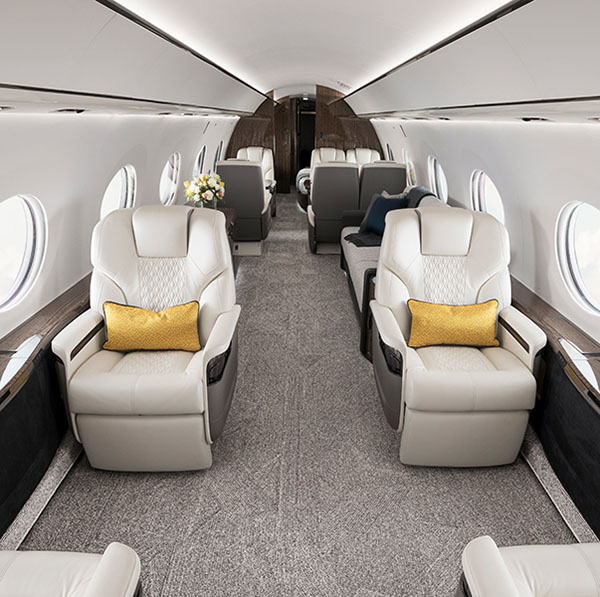
Gulfstream G700 private jet cabin with leather club seats, panoramic windows, central aisle and multi-zone interior
Aircraft Interior / UAE Mission · Weight · Certification · Craftsmanship

Start With the Aircraft and Mission

The right cabin is defined by how the aircraft is actually flown.

Before selecting leather or veneer, tell us the aircraft model, registry, existing configuration, typical sector length, passenger profile and intended scope. A corporate shuttle that flies two-hour sectors needs a different interior from an owner-operated ultra-long-range aircraft used for overnight missions. Certification scope also changes dramatically between re-covering approved seats and altering monuments, seat configuration, systems or structural interfaces.

01

You bought a pre-owned jet and the cabin feels dated

We first separate what can be refreshed cosmetically from what requires approved modification. Carpet, upholstery, plating and selected finishes can transform a cabin without automatically rebuilding its layout, which can reduce downtime and certification complexity.

02

You want a more residential cabin without adding unnecessary weight

We translate residential ideas into aviation construction: thin veneers over lightweight substrates, weight-conscious stone or solid-surface solutions, certified soft goods, compact storage and restrained decorative layers. The objective is richness per kilogram—not simply more material.

03

The aircraft has to support work, dining and sleep on one mission

We use the existing certified geometry intelligently: club seating can serve meetings, conference tables can support dining, divans can become berths where approved, and privacy partitions can divide zones. Multi-use has to work with seat tracks, egress and certified equipment—not against them.

04

You operate several aircraft and want one recognisable cabin identity

We create a fleet palette and repeatable design language across different airframes: upholstery stitching, veneer family, carpet geometry, plated hardware, lighting tone and branded details can align while each aircraft keeps its own approved layout.

05

You want to move seats, bulkheads or add new cabin systems

That becomes a certification-led project. GCAA CAR 21 treats some seating-configuration and design changes as changes to type design; the approved Design Organisation / STC holder determines the compliance route, engineering substantiation and authority approval. Bella's role is to keep the design intent compatible with that process.

What Aircraft Interior Design Has to Balance

Luxury only works when the engineering underneath it still works.

A successful private-aircraft interior is a collaboration between design, certification, engineering, MRO, suppliers and the owner. These seven checks keep the cabin desirable without pretending that aviation constraints are optional.

01

1. Mission profile

Sector length, passenger count, corporate versus private use, overnight flying, crew needs and baggage all affect how cabin zones should be prioritised.

  • Typical sector
  • Passenger count
  • Work / leisure mix
  • Sleep requirements
  • Crew needs
02

2. Certification basis

The aircraft registry, type certificate, existing approvals and modification scope determine which design changes are minor, major or STC-led and which approved organisations must sign them off.

  • Registry
  • Type design
  • Existing STCs
  • DOA / engineering
  • Authority approval
03

3. Weight + balance

Every new finish, monument, system and water feature affects weight. The design team tracks aesthetics against the engineering weight budget because added mass can affect payload, range and balance.

  • Material weight
  • Monument mass
  • Seat changes
  • Water systems
  • Weight & balance
04

4. Flammability + material performance

Aircraft interior finishes and decorative surfaces are not selected from residential samples alone. Applicable flammability tests, smoke / heat-release requirements where relevant, wear, cleanability and supplier certification shape the approved material set.

  • Flammability
  • Smoke / heat where applicable
  • Durability
  • Cleaning
  • Traceability
05

5. Human factors + egress

Seat movement, tables, divans, partitions, bags and loose objects cannot compromise the approved aisle, exits or emergency use. Luxury details have to stay compatible with how passengers move in normal and emergency conditions.

  • Seat envelope
  • Aisle
  • Exit access
  • Berthing
  • Stowage
06

6. Cabin systems

Lighting, CMS, IFE, connectivity, powered tables, shades, seat controls and charging all create electrical, software, antenna, cooling and certification interfaces.

  • CMS
  • IFE
  • Connectivity
  • Lighting
  • Power / USB
07

7. Maintenance + future resale

The interior should still be serviceable after delivery. Access panels, replaceable wear items, standardised hardware and a documented material package help the operator maintain the cabin and can make later refresh work easier.

  • Service access
  • Replaceable soft goods
  • Spare materials
  • Documentation
  • Resale strategy

Aircraft Interior Project Types

A soft-goods refresh and a VVIP completion are completely different programmes.

We define the intervention before proposing design fees or a programme. The scope can range from a focused cosmetic update to a multi-zone interior that requires significant approved engineering and certification.

Real private aircraft cabin with tan leather seats, wood trim and cockpit view
Aircraft Project / 01

Soft-Goods & Cosmetic Refresh

For an otherwise functional cabin that needs a faster visual update. Typical work can include approved seat / divan re-covering, carpet, curtains, sidewall soft goods, selected plating and finish refreshes coordinated through the MRO / completion centre.

Leather / textileCarpetPlatingColour updateShorter downtime
Private aircraft passenger seat beside a large oval window with integrated side ledge and controls
Aircraft Project / 02

Midsize & Super-Midsize Executive Cabin

These cabins need strong space discipline. Club seats, divan, credenza, galley and aft lavatory compete for a narrow fuselage, so the design focuses on visual continuity, compact storage, work surfaces and multi-use seating rather than residential-scale furniture.

Club seatingDivanCompact galleyCredenzaSpace efficiency
Large-cabin private jet conference and dining area with six leather seats and folding wood table
Aircraft Project / 03

Large-Cabin & Ultra-Long-Range Jet

Long-range aircraft can support multiple living zones for work, dining, lounge and sleep. Gulfstream's current G700, for example, is offered with up to five living areas and up to 19 seats, showing how mission zoning becomes a genuine interior-planning exercise at this scale.

Multiple living zonesConference / diningLoungeSleepLong-haul comfort
Gulfstream G700 multi-zone floor plan showing galley, club seating, divan, dining, bedroom and lavatories
Aircraft Project / 04

New-Aircraft / Green Completion Design

For a new aircraft or VIP completion, the design can go deeper into configuration, monuments, sidewall architecture, lighting, material development and bespoke furniture. The approved completion centre and Design Organisation remain responsible for engineering, certification, production and installation.

Cabin architectureCustom monumentsMaterial developmentLightingCertification integration
Private aircraft grand-suite sleeping zone with bed, windows, wood bulkhead and integrated side storage
Aircraft Project / 05

VVIP Airliner / Head-of-State Cabin

ACJ, BBJ and other VIP airliner interiors operate at a much larger scale and can include reception, formal dining, meeting, private suite, guest seating and crew functions. These projects are completion-centre programmes with substantial engineering and certification, not ordinary interior fit-outs.

VVIP zoningFormal diningPrivate suiteCrew / guest separationCompletion management
Consistent large-cabin aircraft interior with repeated seat, carpet and millwork language
Aircraft Project / 06

Fleet Harmonisation

Corporate flight departments often want older and newer aircraft to feel like one fleet. A 2026 Duncan Aviation Falcon 2000EX refurbishment, for example, was intentionally redesigned to match a newer Falcon 2000LXS using coordinated veneer, carpet, hardware, lighting and technology.

Fleet paletteRepeatable detailsHardwareCarpet / leatherConsistent experience
Private jet galley with lightweight wood cabinetry, stone-look counters, integrated appliances and cabin controls
Aircraft Project / 07

Galley, CMS, Lighting & Connectivity Refresh

Owners often combine cabin refurbishment with avionics / cabin technology downtime. A design refresh can coordinate the visual impact of new LED lighting, connectivity, touch controls, display systems, charging and galley upgrades with the existing interior.

CMSConnectivityLED lightingDisplaysGalley

What Aircraft Interior Design Can Include

The scope is divided between design intent and certified aircraft engineering.

Bella can develop the cabin vision, spatial priorities, finish language and owner-facing design package. The approved aviation organisations then determine compliance, substantiation, manufacture and installation. Keeping that boundary clear prevents a beautiful concept from becoming un-certifiable.

01

Owner brief + mission analysis

We translate how the aircraft is used into design priorities.

  • Aircraft type / serial / registry information
  • Existing approved layout
  • Typical passenger count
  • Sector length
  • Corporate / family / charter use
  • Work / dining / sleep requirements
  • Crew requirements
  • Baggage / wardrobe needs
  • Privacy expectations
  • Resale / fleet strategy
02

Cabin zoning + layout design intent

Layout work is developed within the certified geometry and engineering route.

  • Club seating relationships
  • Conference / dining zone
  • Divan / lounge
  • Private suite
  • Crew rest interface
  • Galley
  • Lavatory
  • Credenza / storage
  • Baggage access
  • Privacy partitions
03

Materials + colour specification

The visual palette is developed using aviation-suitable candidate materials for later approval / testing.

  • Leather
  • Ultraleather / technical upholstery
  • Wool / aviation carpet
  • Veneer
  • High-pressure / technical laminates
  • Decorative plating
  • Stone-look / lightweight stone concepts
  • Solid-surface concepts
  • Curtains / soft goods
  • Stitching / quilting
04

Cabinetry + monument design intent

Furniture-like elements are treated as aircraft monuments, not residential joinery.

  • Credenzas
  • Conference tables
  • Side ledges
  • Wardrobes
  • Media cabinets
  • Galley fronts
  • Lavatory vanity
  • Storage
  • Pocket / sliding partition concepts
  • Latches / hardware finish
05

Lighting + cabin technology

The atmosphere is coordinated with certified aircraft systems.

  • Ambient LED scenes
  • Reading light intent
  • Night / sleep mode
  • Accent lighting
  • CMS interface hierarchy
  • Display integration
  • Connectivity interface
  • USB / charging locations
  • Window shade interface
  • Technology concealment
06

Visualisation + owner approvals

Aircraft design decisions are easier to approve when the owner can see the complete cabin rather than isolated samples.

  • Mood boards
  • Material boards
  • Colour studies
  • Cabin elevations
  • 3D visuals
  • Zone-by-zone renderings
  • Stitch / quilting studies
  • Plating samples
  • Carpet artwork
  • Full-scale mock-up review where commissioned
07

Completion / MRO coordination support

We coordinate design intent with the organisation legally responsible for the aircraft work.

  • Design Organisation interface
  • MRO / completion-centre coordination
  • OEM interface
  • Material substitution review
  • Weight-conscious value engineering
  • Certification-driven design revisions
  • Production sample review
  • Cabin inspection support
  • Punch-list / cosmetic snagging
  • Final material / finish record

Bella's interior-design scope does not itself approve an aircraft modification for flight. Structural substantiation, flammability compliance, seat certification, electrical / systems engineering, weight-and-balance revision, approved data, STC / minor-change approval, installation and return-to-service must be performed and signed by the appropriately approved aviation organisations for the aircraft and registry.

From Mission Brief to Redelivery

How an aircraft interior project moves forward

The best time to solve certification, procurement and downtime problems is before the aircraft enters the hangar. We front-load the design and coordinate the approved parties early.

01

Aircraft + mission brief

We review model, registry, existing layout, maintenance timing, owner profile, mission length, passenger use, technology needs, desired scope and redelivery target.

Output: aircraft design brief + constraints
02

Existing cabin survey + approved-data review

The current configuration, monuments, seats, materials, systems and known approvals are documented with the MRO / engineering team so the concept is based on the actual aircraft.

Output: existing-condition / certification baseline
03

Concept + zoning

We develop layout intent, colour, material, furniture / monument character, lighting and owner-experience options while the approved design organisation identifies certification implications.

Output: preferred cabin concept
04

Material + sample development

Candidate leather, carpet, veneer, plating, solid-surface / lightweight stone and soft goods are reviewed for appearance, weight and certification pathway before final owner approval.

Output: approved material / finish package
05

Engineering + certification coordination

The authorised aviation team develops drawings, substantiation, flammability data, structural / electrical analysis, approved change data and STC / minor-change route as applicable. Design adjustments are incorporated before manufacture.

Output: certification-coordinated design intent
06

Production + installation review

Cabinetry / monuments, seat upholstery, carpet, plated hardware, lighting and soft goods are reviewed through samples and production milestones while the MRO controls installation and quality documentation.

Output: production-approved design package
07

Cabin inspection + redelivery

The installed cabin is reviewed for colour consistency, stitching, grain / veneer alignment, hardware, lighting scenes and cosmetic snags while the approved aviation parties complete tests, documentation and return-to-service.

Output: design close-out + redelivery support

Aircraft Interiors Are Certified Products

A material can be beautiful, lightweight and still be unusable until its compliance route is proven.

The technical framework depends on the aircraft and registry. In the UAE, GCAA CAR 21 governs type-design changes and supplemental type certificates; EASA / FAA rules may also matter where the aircraft, approved data, Design Organisation or completion centre uses those certification bases. The approved engineering team decides what applies to the specific project.

Gulfstream G700 galley and cabin showing integrated monuments, appliances, controls and narrow aircraft circulation
01

GCAA CAR 21 determines the modification route

CAR 21 separates type-design changes by scope and contains the UAE supplemental type-certificate framework. Its guidance lists a change to seating configuration among examples requiring design assessment. The approved Design Organisation decides whether a proposed cabin change is minor, major, STC-based or otherwise approved for that aircraft.

02

Decorative surfaces are part of flammability compliance

For transport-category aircraft, FAA 14 CFR 25.853 and EASA CS 25.853 state that cabin materials—including finishes or decorative surfaces applied to them—must meet the applicable Appendix F test criteria. Seat cushions have additional test requirements. This is why residential fabric, leather, veneer coating or adhesive cannot simply be specified unchanged for an aircraft.

03

Applicable seats are dynamic safety systems—not lounge chairs

Transport-category seat certification under 25.562 includes dynamic emergency-landing tests. The current FAA rule includes a minimum 14 g peak vertical floor deceleration case and a minimum 16 g forward longitudinal case for applicable seat designs. Any re-design around certified seats has to preserve the approved seat / restraint function.

04

Weight is an interior-design metric

A 2026 Business Jet Interiors feature on lightweighting notes that each kilogram affects range, fuel burn, payload flexibility and operating economics. Gulfstream likewise states that actual aircraft weights are affected by outfitting options. We therefore compare finish depth, substrate, hardware and monument construction against the engineering weight budget.

05

Veneer is not ordinary millwork

Aviation cabinetry typically uses lightweight cores and thin decorative faces rather than solid residential construction. Grain matching, gloss, edge protection and repairability can still deliver a furniture-grade appearance while the certified structure remains weight-conscious.

06

Decorative plating affects both appearance and documentation

Seat hardware, latches, escutcheons and cabin details can be refinished in nickel, chrome, bronze, gold-tone or other approved decorative systems. The completion centre controls substrate compatibility, process specification, part marking / traceability and whether the re-finish is allowed on each component.

07

Stone has to become an aviation product

A stone appearance may be achieved through very thin real stone, lightweight backed stone, engineered surfaces or alternative materials. The selected solution must satisfy weight, attachment, flammability / test requirements where applicable, crack resistance and certification—not residential countertop thickness.

08

Cabin management systems make the interior interactive

Lighting, shades, temperature interfaces, displays, audio, seat functions and connectivity can be coordinated through the CMS. A visual redesign should identify the desired user experience early because new displays, wiring, controls or antennas can create engineering and certification scope.

09

The aisle and exits are not available design space

Seat tracking, table deployment, divan depth, ottomans and loose accessories must remain compatible with the approved seating / egress arrangement. A render showing oversized residential furniture is meaningless if it blocks an aisle or cannot be restrained for flight.

10

Galleys combine interior design with aircraft systems

Ovens, coffee equipment, chillers, potable water, waste, latches, electrical loads and fire-safety provisions sit behind the cabinetry. We design the visible galley language around the approved equipment package rather than selecting domestic appliances.

11

A full cabin removal changes weight-and-balance control during maintenance

Jet Aviation documented a G450 refurbishment where the stripped aircraft needed additional temporary weights attached to seat tracks so it could fly to a paint facility within its flight envelope. It is a useful reminder that cabin mass is part of the aircraft—not just interior decoration.

UAE Aircraft Modification & Certification

The aircraft can only fly the new interior when the approved aviation chain accepts it.

The GCAA is the UAE's federal civil-aviation authority. For UAE-registered aircraft, CAR 21 provides the certification framework for products, parts, design organisations and changes to type design. The precise approval route depends on the aircraft and the proposed modification.

GCAA CAR 21 guidance shows that even apparently interior-only work can become a design change: seating-configuration changes and lightweight floor-panel changes are examples within the supplemental-type-certificate guidance. The engineering organisation therefore needs to review the concept before Bella or the owner assumes a layout change is cosmetic.

Where the project uses EASA or FAA approved data, their certification standards can also be relevant. EASA CS 25.853 and FAA 14 CFR 25.853 both impose flammability requirements on applicable cabin materials and decorative surfaces; applicable seat designs are subject to crashworthiness requirements such as CS / CFR 25.562.

The UAE has substantial cabin-modification capability. Etihad Engineering in Abu Dhabi states that it holds EASA Part 21J and GCAA Part 21J Design Organisation approvals and can perform minor and major (STC) cabin conversions on large commercial and VIP aircraft. Its Abu Dhabi cabin services also include on-site flammability testing, seat / carpet fabrication, galley, sidewall and monument refurbishment.

Dubai also has business-jet refurbishment capability. Jet Aviation's Dubai facilities offer interior refurbishment and documented their first full Dubai business-jet cabin refurbishment on a Gulfstream G450 in 2023. ExecuJet MRO Services Middle East completed a full Legacy 650 cabin refurbishment in 2026, including re-varnished cabinetry, carpet, sidewalls, ceiling, replating and redesigned / reupholstered seats.

Bella's design appointment should therefore be integrated with the owner's chosen OEM, approved Design Organisation, Part 145 / MRO, completion centre and suppliers. We can lead the aesthetic and owner-experience brief, but those approved entities own the airworthiness data, certification, manufacture, installation and release-to-service responsibilities.

  • Confirm aircraft model, serial number, registry and current approved configuration
  • Identify the Design Organisation / engineering approval route before changing layout
  • Confirm whether the work is repair, cosmetic refurbishment, minor change, major change or STC scope
  • Confirm the applicable flammability / material-test requirements
  • Freeze seat models and approved track positions before final interior planning
  • Track material / monument weight and update weight-and-balance through the responsible organisation
  • Confirm approved power, CMS, IFE and connectivity architecture before adding devices
  • Use completion-centre / OEM approved materials, processes and suppliers where required
  • Coordinate production drawings and installation instructions with the approved organisation
  • Preserve emergency egress, signs, safety equipment and maintenance access
  • Complete all required conformity, testing, documentation and return-to-service before aircraft operation
Read the current UAE GCAA — CAR 21 Certification of Aircraft and Related Products
Private jet grand suite with light bedding, dark wood veneer, neutral sidewalls and large aircraft windows

Aircraft Colour, Materials & Perceived Space

The cabin palette has to look luxurious in daylight, night mode and a curved fuselage.

The supplied research is right that light upper surfaces can make a narrow cabin feel more open, while deeper materials at the floor / cabinetry level can visually anchor it. We keep that principle but avoid claims that a particular colour automatically regulates circadian rhythm or lowers heart rate; lighting and passenger comfort are multi-factor issues.

Every candidate material remains subject to the aircraft's approved specification and test route. A residential leather, carpet, veneer lacquer or adhesive can be visually perfect and still be rejected if its construction, finish build-up or certification data do not satisfy the applicable aircraft requirements.

Gloss is used carefully. High-gloss veneer can increase visual depth, but reflections from windows, monitors and LED strips can become distracting. Matte / satin materials can feel more contemporary and hide fingerprints better, but must still meet cleaning and wear requirements.

Timeless corporate — Alabaster Silk #F4F1EA · Taupe Warmth #D1C7BD · Smoked Walnut #2F2520 · Satin Champagne #D4AF37Ultra-long-range calm — Cirrus Gray #EAEAE6 · Parchment #E2DEC9 · Deep Slate #4A5B66 · Bleached Oak #8B7E74Modern stealth — Glacier #DCDCDC · Charcoal Obsidian #363636 · Carbon #1F2421 · Gunmetal #708090Warm contemporary — Cloud Ivory #F2EFE8 · Cognac #9A684B · Walnut #4B342A · Soft Graphite #55575BUpholstery — aviation-approved leather, technical leather / synthetic leather and textiles selected to seat / divan approval, wear and flammability requirementsCarpet — aviation-qualified wool / wool-blend or other approved constructions developed around weight, pile, pattern, cleaning and certificationVeneer — thin decorative veneer / engineered decorative face on lightweight approved substrate rather than residential solid-wood cabinetryPlating — nickel, chrome, bronze, gold-tone, gunmetal or other approved decorative plating coordinated with substrate, part approval and wearCountertops — lightweight solid-surface, thin stone / stone veneer, composite or approved engineered alternatives rather than full residential slab constructionSoft goods — curtains, pillows, bedding and decorative textiles controlled according to their installation / stowage status and the applicable certification requirements

Aircraft Interior Budget & Downtime

Price the certification scope first; luxury materials come second.

A cabin project can mean new carpet and leather or a full interior removal, monument rework, CMS / connectivity upgrades and certification. Those scopes should never be compared as if they were the same product. The figures below are external market references converted at the CBUAE USD/AED rate of 3.6725 available on 2 October 2026; they are not Bella quotations.

External aircraft-interior benchmarks

Useful reference points for an owner budgeting a refurbishment

  • Large-cabin soft goods: Guardian Jet's refurbishment guide estimates about USD 200,000 to re-cover seats in new leather on an ultra-long-range aircraft—approximately AED 734,500 at the current CBUAE rate.
  • Large-cabin carpet: the same Guardian Jet guide gives USD 40,000–90,000 for carpet replacement—approximately AED 146,900–330,525.
  • Large-cabin woodwork: Guardian Jet gives roughly USD 300,000–500,000 to refinish woodwork—approximately AED 1.10–1.84 million.
  • Current 2026 broader programme context: an aviation design / oversight specialist writing for GlobalAir says full interior + exterior refurbishments she works on commonly run about USD 1.5–6 million—approximately AED 5.51–22.04 million. This includes exterior work and is not an interior-only benchmark.
  • A current 2026 refurbishment on an Embraer Legacy 650 in Dubai included complete cabinetry re-varnish, carpet replacement, new dado / sidewall / ceiling coverings, replating and redesigned seats with new foam and leather—illustrating the scope that can sit behind the phrase 'full cabin refurbishment' even when no public project price is given.
  • New VVIP / green completions can be substantially more expensive because they can add new monuments, structures, systems, engineering and certification. Bella does not publish a generic VVIP completion figure without the airframe and approved scope.
  • Bella's design fee is quoted separately after reviewing aircraft type, existing condition, whether layout changes are requested, number of bespoke material developments, visualisation / mock-up scope, travel, completion-centre interface and expected project duration.
Downtime is shaped by

Design and material approval should happen before the maintenance slot starts

  • Aircraft / registry certification route
  • Approved Design Organisation availability
  • MRO / completion-centre slot
  • Seat / monument engineering
  • Material flammability tests and certification data
  • Custom veneer / carpet / leather lead times
  • Decorative plating
  • CMS / connectivity / avionics modifications
  • OEM / supplier approvals
  • Maintenance findings discovered after cabin removal
  • Paint / exterior work if combined with the visit
  • Conformity, testing and return-to-service documentation
  • Guardian Jet's industry guide gives roughly 6–10 weeks for a large-aircraft soft-goods refurbishment and around 14–16 weeks of downtime for a complete refurbishment. These are historical industry benchmarks, not guaranteed slots.
  • Current market reality can be longer before the aircraft even enters the hangar: a September 2026 GlobalAir article notes that completion-centre availability can itself create months of waiting, which is why pre-planning matters.

For a meaningful first review, send the aircraft model / serial, registry, existing cabin photos and layout, maintenance / refurbishment slot, typical mission, passenger count, changes you want, technology upgrades under consideration and target redelivery date.

Aircraft & Private Jet Interior Design, Explained

Aircraft Interior Design — Frequently Asked Questions

These answers cover the questions aircraft owners and searchers actually ask: cost, certification, designers, materials, cabin style, lifespan, AI, salary and celebrity-aircraft claims.

01What is aircraft interior design?

Aircraft interior design is the spatial, material and experiential design of the passenger cabin within an airworthy aircraft. In business aviation it covers layout intent, seating relationships, monuments, galley / lavatory appearance, leather, carpet, veneer, plating, lighting, CMS / IFE interfaces and visualisation, all coordinated with certified aviation engineering.

02Who designs private jet interiors?

The finished cabin is collaborative. An aviation interior designer develops the owner experience and visual direction; an approved Design Organisation / engineering team develops compliant design data; OEMs, seat and equipment suppliers provide approved products; and an approved MRO or completion centre manufactures / installs the work and returns the aircraft to service.

03What is private jet style?

There is no single private-jet style. Current cabins range from light corporate neutrals and high-gloss walnut to matte oak, darker contemporary palettes, automotive-inspired stitching and residential-style lounges. The common factor is not the style—it is that the selected materials and components are translated into lightweight, certifiable aviation construction.

04How much does a private jet interior cost?

Scope changes the answer completely. Guardian Jet's large-cabin reference gives about AED 734,500 equivalent for seat re-leathering, AED 146,900–330,525 for carpet and AED 1.10–1.84 million for woodwork refinishing at the 2 October 2026 CBUAE USD/AED rate. Full interiors with technology, cabinetry and certification can move into multi-million-dirham programmes.

05How much can a full private-jet refurbishment cost?

A September 2026 GlobalAir article from an aviation design / oversight specialist says full interior plus exterior refurbishment programmes she works on commonly run about USD 1.5–6 million, approximately AED 5.51–22.04 million at the current CBUAE conversion. Because that figure includes exterior work, it should not be treated as an interior-only quote.

06How long does a private jet interior refurbishment take?

Guardian Jet's industry guide gives roughly 6–10 weeks for a large-aircraft soft-goods refurbishment and about 14–16 weeks for a complete refurbishment. Actual calendar time can be longer because engineering, materials, tests and completion-centre slots happen before the physical installation.

07Can Bella change the seat layout or move a bulkhead?

Bella can develop the design intent, but the approved Design Organisation determines whether the change is permitted and what certification route applies. GCAA CAR 21 treats seating-configuration changes as design changes that require engineering assessment, and larger modifications may require STC-approved data.

08Do all aircraft interior materials need fire testing?

Applicable requirements depend on the aircraft and material, but for transport-category aircraft FAA 25.853 and EASA CS 25.853 require interior materials—including finishes and decorative surfaces—to meet applicable Appendix F test criteria. Seat cushions have additional requirements. The completion / engineering team confirms exactly which tests and data apply.

09Why can't you use normal residential leather, carpet or wood?

The visual material may look similar, but the complete aviation construction has to meet applicable flammability, weight, attachment, wear and certification requirements. Adhesive, foam, backing, lacquer and substrate can matter just as much as the visible leather or veneer.

10Are private-jet seats really designed for 16 g?

For applicable transport-category seat designs, current FAA 25.562 includes dynamic emergency-landing test cases with a minimum 14 g peak vertical floor deceleration and a minimum 16 g forward longitudinal case. This is one reason a certified aircraft seat cannot be treated like a residential lounge chair.

11How do designers make a private jet feel larger?

Use visual continuity rather than oversized objects: lighter upper sidewalls, controlled contrast, long horizontal lines, concealed storage, consistent flooring, low visual clutter, correctly scaled furniture, aligned lighting and full use of window light. The actual aisle and certified envelope remain fixed.

12What colours work well in a private jet?

A timeless corporate palette can use Alabaster #F4F1EA, Taupe #D1C7BD, Smoked Walnut #2F2520 and Champagne Gold #D4AF37. A calmer long-range palette can use Cirrus #EAEAE6, Parchment #E2DEC9, Deep Slate #4A5B66 and Bleached Oak #8B7E74. A modern darker cabin can use Glacier #DCDCDC, Charcoal #363636, Carbon #1F2421 and Gunmetal #708090.

13What is decorative plating for aircraft interiors?

It is the controlled refinishing or manufacture of visible metal hardware—such as latches, escutcheons, seat details and trim—in finishes such as nickel, chrome, bronze, gold-tone or gunmetal. The approved aviation provider controls process compatibility, part condition, documentation and whether each component may be replated.

14Can a private jet have a real stone bathroom or countertop?

Yes, but generally not as a residential-thickness slab. Aviation projects use lightweight backed stone, very thin stone, composite or other engineered solutions according to weight, attachment and certification requirements. The approved completion team validates the final system.

15Can a private jet have a bedroom and shower?

Large-cabin and VVIP aircraft can. Gulfstream's current G700 offers cabin configurations with up to five living areas and promotes a grand-suite option with shower. Whether a refurbishment can add such a feature depends on the specific aircraft, water / waste systems, structure, weight, engineering and certification.

16What is trending in private jet interiors in 2026?

Current 2026 industry coverage emphasises lightweighting, deeper personalisation, more residential but restrained cabins, high-speed connectivity, integrated CMS / lighting, fleet consistency, material sustainability and technology that becomes less visually intrusive. Lightweighting remains a central engineering priority because every kilogram affects aircraft performance and operating economics.

17Is AI replacing aircraft interior designers?

No. AI is increasingly used for concept exploration, optimisation and safety / simulation workflows, but aircraft interiors still need accountable human decisions across owner briefing, ergonomics, material approval, certification, engineering and installation. DLR showcased AI-supported cabin safety analysis at Aircraft Interiors Expo 2026, which is a good example of AI augmenting rather than replacing the regulated design process.

18How much do private jet interior designers make?

There is no reliable UAE-wide salary specific to private-jet interior designers. As one external reference, Salary.com reported an average U.S. Aircraft Interior Designer salary of about USD 45,921 per year on 1 September 2026, while other salary aggregators publish different figures. Senior aviation designers, design directors and independent completion consultants can have very different compensation, so one salary number should not be treated as a global benchmark.

19What is the highest-paid interior design job?

There is no authoritative worldwide ranking. Principals, design directors, owners of successful practices and specialists working on high-value aviation, yacht, hospitality or luxury projects can earn more than generalist roles, but compensation depends on market, responsibility, reputation and whether the person owns the business.

20What is the lifespan of a private jet?

There is no single design-life number that applies to every business jet. Aircraft can remain in service for decades when maintenance, inspections, parts support and airworthiness remain viable. A 2026 NBAA article notes that many owners now keep an aircraft for only about five to seven years before replacing it, but that is an ownership cycle—not the physical lifespan of the aircraft.

21How much is Elon Musk's private jet?

An exact current purchase price for an individual's aircraft is not a reliable public figure. Business Insider has reported a Gulfstream G650 associated with Musk's 2026 travel and previously identified him as a G700 customer. For market context, current September 2026 G650ER listings are around USD 45.75–45.95 million—about AED 168.0–168.8 million at the current CBUAE rate—while a G700 was reported around USD 81 million when showcased in 2024. Those are aircraft benchmarks, not confirmed transaction prices for his specific aircraft.

22Does Shah Rukh Khan own a private jet?

Public reporting does not support stating that as a confirmed current fact. In a 2017 Indian Express interview he said he did not own one at that time. A 2025 report showing him inside a private jet explicitly said it was not known whether he owned the aircraft or was travelling as a guest / charter passenger. The cabin design should therefore not be described as 'his jet' without verified ownership.

23Can refurbishing a cabin help aircraft resale?

It can improve presentation and marketability, but it does not guarantee full cost recovery. Current 2026 industry coverage shows professionally executed cabin refurbishments helping older large-cabin aircraft compete for buyer attention, while mechanical condition, maintenance status and market demand remain decisive.

24Can a refurbishment be combined with a major maintenance check?

Yes, and that can be efficient because the aircraft is already down and parts of the cabin may already be removed. ExecuJet Dubai documented a Global 6000 project combining a heavy maintenance check, landing-gear work, satcom installation and cabin refurbishment. The schedule still needs careful coordination so one workstream does not delay the others.

25What should I send Bella before we start?

Send the aircraft make / model, serial number if available, registry, current cabin layout and photographs, typical mission, passenger count, maintenance or refurbishment slot, existing MRO / completion-centre contact, changes you want, technology upgrades under consideration and target redelivery date.

Your Aircraft, Properly Briefed

Tell us the airframe and mission before you tell us the leather colour.

Share the aircraft make / model, serial or tail information if appropriate, registry, current cabin photos / layout, typical mission, passenger count, desired changes and target downtime. If an MRO, OEM or completion centre is already appointed, include that information so the design can be coordinated with the approved technical route.

If you want to move seats, add a partition, change monuments, install new connectivity / CMS equipment, alter the galley or add a shower / new water system, flag that at the beginning. Those requests can materially change engineering, certification, weight and downtime.